To cut a tomato, rinse it, cut out the stem end with the tip of the knife, then choose the cut for the dish: crosswise rounds for burgers and sandwiches, wedges for salads, or a dice for tacos and salsa. Once a tomato is halved, set it cut-side down so it cannot roll. A sharp straight edge or a serrated knife gets through the skin without squashing the fruit; a knife that skids on the skin needs attention before it goes near your fingers.
Purdue Extension describes beefsteak tomatoes as large and meaty, good for slicing, sandwiches and salads, and salad tomatoes as medium-sized and good for slicing. Plum and Roma tomatoes are often less juicy, so Purdue suggests them for sauces or drying.
Wash and core
Purdue’s advice is to wash tomatoes under cool running water before use, and the FDA’s produce guidance is to cut away any damaged or bruised areas before preparing them. Kikkoman’s cutting guide uses the tip of the knife to remove the stem before slicing rounds; for wedges, it halves the tomato lengthwise and removes the stem with a small V-shaped cut on each side.
Step by step: the four everyday cuts
- Rounds for burgers and sandwiches. Remove the stem, lay the tomato on its side and slice across it at consistent widths from end to end, as Kikkoman describes. Choose the thickness the sandwich needs and keep it even.
- Half-moons. Cut the tomato in half from top to bottom, remove the stem, set each half cut-side down and slice it at consistent widths.
- Wedges for salads. Halve the tomato lengthwise, take out the stem with a V-shaped cut, then cut from the center of the cut face into equal wedges.
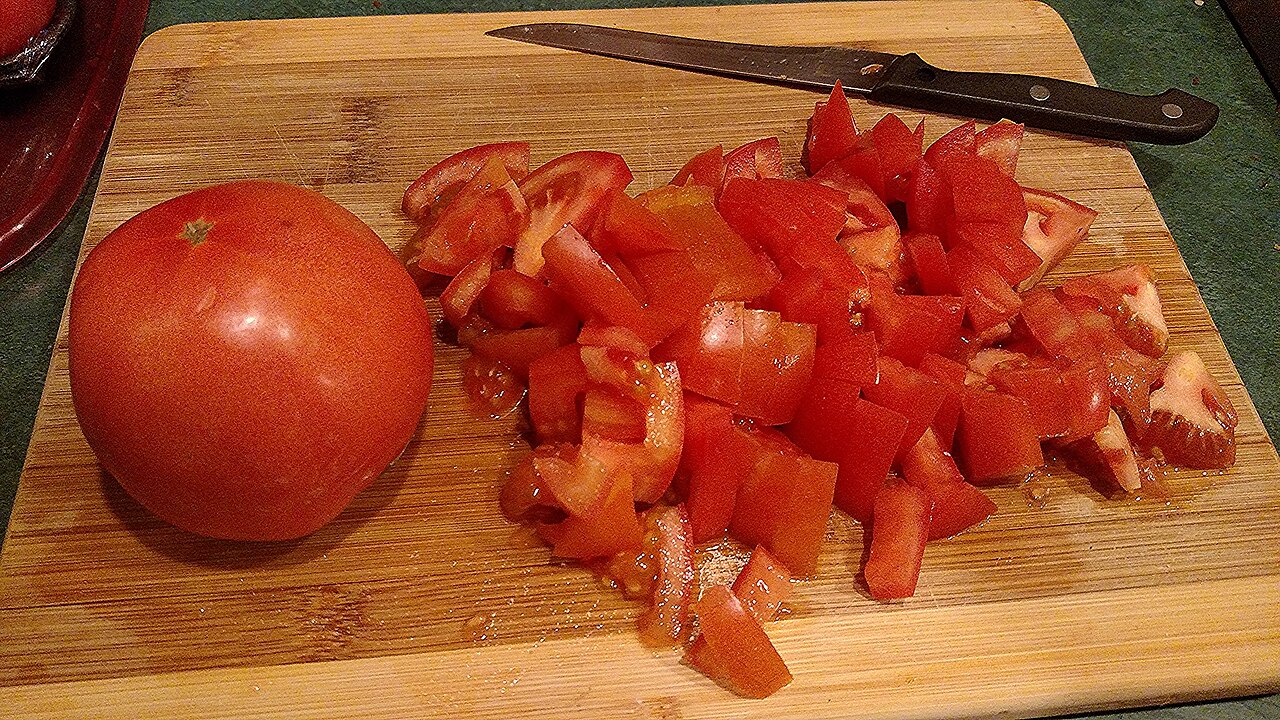
- Dice for tacos and salsa. Kikkoman carves out the stem, halves the tomato horizontally and cuts it vertically and horizontally into pieces 1 to 1.5 cm (about ½ inch) wide. To remove the seeds, scoop them out with your fingers after the horizontal cut. Utah State Extension’s knife-skills handout defines a small dice as ¼-inch cubes and a medium dice as ½-inch cubes.
Cuts by dish
| Dish | Cut | Tomato |
|---|---|---|
| Burgers and sandwiches | Crosswise rounds | Beefsteak or salad |
| Green salads | Wedges or half-moons | Salad or beefsteak |
| Tacos, salsa, chopped salads | Small or medium dice, seeds out if you like | Any firm tomato |
| Sauces | Rough chop | Plum or Roma |
Keep your fingers clear
Mississippi State Extension’s knife basics ask you to tuck the fingertips of the guiding hand toward your palm, and to give round food a flat surface before cutting it. A whole tomato on its side can roll, so hold it with curled fingers while you slice rounds; for every other cut, halve it first and work from the flat face. Our sharpness check uses one slow, light slice through a tomato for the same reason: if the edge will not start the cut, stop rather than pressing harder.
Storing tomatoes
Purdue recommends storing whole tomatoes at room temperature and out of direct sunlight, and eating them soon after harvest for the best flavor.
The knife for this job
Mississippi State Extension lists a serrated knife as good for cutting soft-skinned produce like tomatoes. A sharp straight edge works too: our paring vs utility knife guide notes that a utility knife gives more edge for slicing a tomato, and a petty knife covers the same small jobs. For a bowl of salsa, a santoku or gyuto gives a longer edge for the dice. In our wa handle size guide, a 105–155mm petty takes the Compact handle, a 150–190mm santoku the Mid-size, and a 196–255mm gyuto the Chef size.
Sources: Purdue Extension FoodLink, tomato (types, washing, storage); FDA, Selecting and Serving Produce Safely (damaged areas); Kikkoman, rounds, half-circle slices, wedge cut and roughly chopped (tomato cuts and sizes); Utah State University Extension, Knife Skills handout (dice sizes); Mississippi State University Extension, Kitchen Knife Basics (serrated knife for tomatoes, curled fingertips, flat surface).