Color-coded cutting boards give each food group its own board, so raw meat, poultry and fish never share a surface with food that will not be cooked. In US food service the most common pattern is red for raw meat, yellow for raw poultry, blue for raw fish and seafood, green for fruit and vegetables, white for dairy and bread, and brown for cooked meat. There is no single official standard, though: USDA’s advice is simply to keep separate boards, and the colors only work if everyone in the kitchen uses the same key.
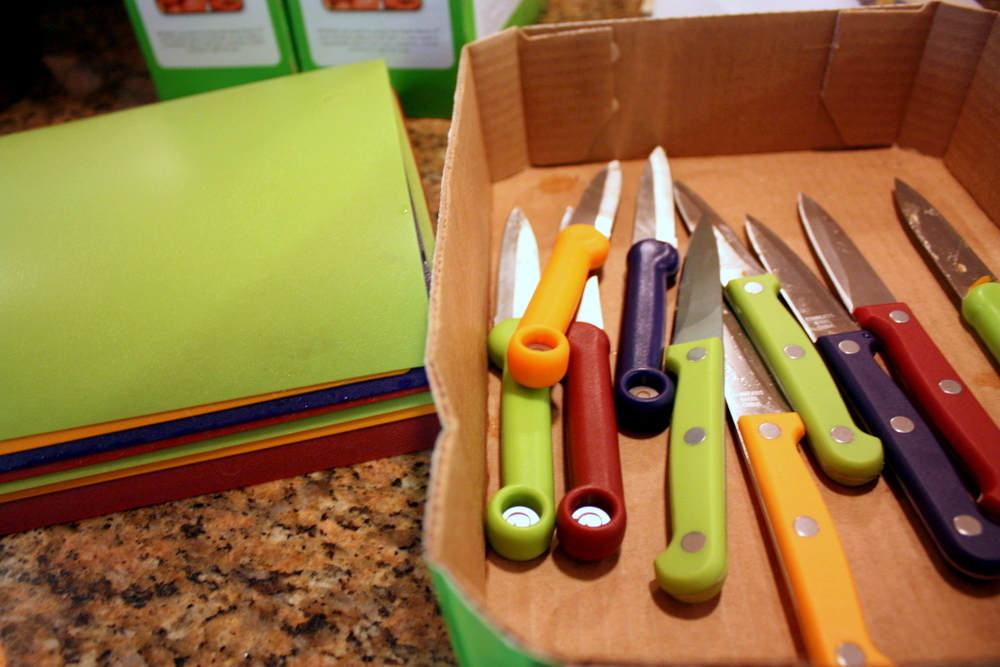
The common color key
| Color | Usual use | Why it is kept apart |
|---|---|---|
| Red | Raw red meat: beef, pork, lamb | Raw juices and trim stay away from ready-to-eat food |
| Yellow | Raw poultry | A dedicated surface for chicken, turkey and duck |
| Blue | Raw fish and seafood | Seafood prep kept separate from other foods |
| Green | Fruit, vegetables, salads, herbs | These often go straight to the plate |
| White | Dairy, bread and bakery | Ready-to-eat foods |
| Brown | Cooked meat | Cooked food kept off raw-meat boards |
| Purple (some kitchens) | Allergen-free preparation | Food free from a particular ingredient |
The table follows the charts published by StateFoodSafety and FoodDocs. The two agree on most colors, and FoodDocs adds purple for allergen-free food. Charts from other sources and other countries assign some colors differently, so treat any chart as a house rule to agree on, not a regulation to look up.
What the food-safety agencies actually say
USDA’s Meat and Poultry Hotline says consumers may use wood or a nonporous board for raw meat and poultry, and suggests one board for fresh produce and bread and a separate one for raw meat, poultry and seafood. It does not assign colors. FoodDocs makes the same point: USDA and FDA recommend separate boards for raw and cooked foods, and color coding is a voluntary way to make that separation easy to follow. Color does not clean anything. Wash every board in hot, soapy water after use, and USDA adds that both wooden and plastic boards can be sanitized with 1 tablespoon of unscented liquid chlorine bleach per gallon of water.
A simpler version for a home kitchen
You do not need six boards. A home cook can keep the principle with two: one board, of any color or material, kept only for raw meat, poultry and fish, and another for everything that will not be cooked. If both are wood, mark one so it never gets mixed up. John Boos, which makes wooden boards, gives the same advice: use one board for raw meat, poultry or fish and another for cooked or ready-to-eat foods. Our guide to the best cutting board for raw meat compares the materials for that job.
Replace a colored plastic board like any other: USDA says boards that are excessively worn or have hard-to-clean grooves should be discarded. For plastic and microplastics, see our non-toxic cutting board guide.
What this means for your board and knife
Most color-coded boards are plastic, which is fine for a knife edge; the surfaces to avoid are glass and stone, explained in glass, marble and stone cutting boards. Keep your best knife on your best board for vegetables and bread, and wash and dry the knife between raw and ready-to-eat tasks; our wooden board cleaning guide covers the board side, and the knife maintenance schedule the knife side.
Sources: StateFoodSafety, How to Use Color-Coded Cutting Boards; FoodDocs, US cutting board color chart (voluntary scheme; USDA/FDA recommend separate boards); USDA FSIS, Cutting Boards and Food Safety (archived copy: separate boards; washing; bleach solution; replace worn boards); John Boos FAQ (separate boards for raw and ready-to-eat food).