A gyuto is a chef’s knife. Gyūtō (牛刀, “beef knife”) is the Japanese name for the Western chef’s knife, and both do the same all-purpose job: vegetables, boneless meat, herbs and most everyday board work. What changes is the build of the individual knife: its weight, how the edge is ground, how hard the steel is and what kind of handle it wears. Compare those on the actual model, not the name on the box.
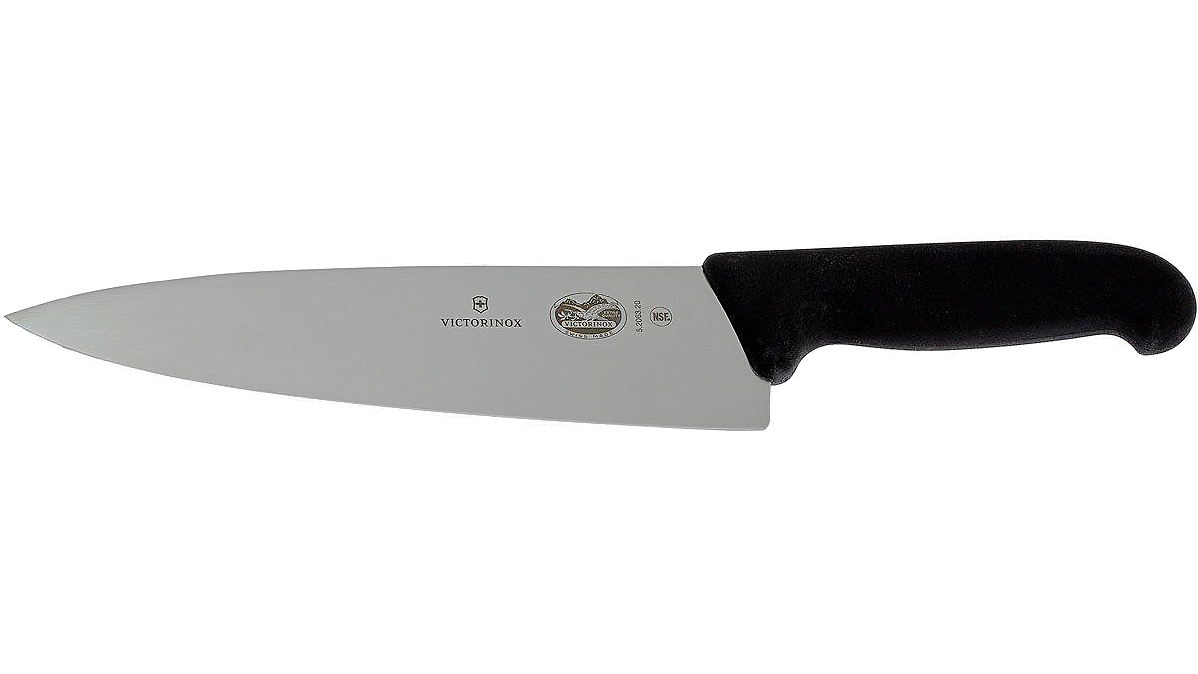
Gyuto vs chef’s knife at a glance
Three knives of about the same length, with every figure as the seller lists it:
| Victorinox Fibrox Chef’s Knife (5.2063.20) | Togiharu PRO Gyuto 210mm (Korin) | Korin Kaguya Wa-Gyuto 210mm | |
|---|---|---|---|
| Style | Western chef’s knife | Gyuto with a Western-style handle | Gyuto with a wa (Japanese) handle |
| Blade length | 7.9 in (about 200mm) | 210mm (also sold in 240mm) | 210mm (also sold in 240mm) |
| Weight | 6.4 oz (about 181g) | 164g | 169g |
| Edge as listed | “Straight edge”; no bevel split given | 70/30 bevel | 50/50 bevel |
| Steel and hardness | Not stated on the product page | 440 16Cr. Molybdenum, stain-resistant, HRC 58–59 | White Steel #2, carbon steel, HRC 64–65 |
| Handle | Thermoplastic elastomer, “non-slip” | POM resin, 4.5 in | Magnolia wood, 5.35 in, water buffalo horn bolster |
| Care the seller notes | Dishwasher safe: “Yes” | None beyond the steel type | “Moisture and acid causes rust and discoloration” |
| Who it suits | A shared kitchen that wants a light, low-fuss all-rounder | A cook who wants a gyuto build with a familiar handle | A cook who will dry the blade and sharpen a hard carbon edge |
Sources: Victorinox, Korin, Togiharu PRO Gyuto, Korin, Kaguya Wa-Gyuto. One sample of three knives shows how builds differ; it is not a rule for every gyuto or every chef’s knife.
What actually differs
Weight. In this sample both 210mm gyuto are lighter than the shorter Victorinox. Korin describes Japanese chef knives as “lightweight and thin”. Heavier gyuto and lighter Western knives both exist, so read the listed weight rather than assuming it from the name.
The edge. Japanese sellers often list the bevel split. A 50/50 edge is ground equally on both sides; a 70/30 edge is ground more on one side, and Korin offers a left-hand conversion for the Togiharu PRO. If you cut left-handed, our guide to left-handed Japanese knives explains what to check.
Steel. Even between the two Korin gyuto in the table, hardness differs: HRC 58–59 against 64–65. A harder edge is one half of a trade-off; Japanese vs German knives explains what you give up for it.
Profile. Western chef’s knives come in two common shapes. Wikipedia’s chef’s knife article describes the French style as straighter until it curves up to the tip, and the German style as gently curved along the whole edge. Gyuto profiles vary by maker too, so compare side-on photos.
Handle. A gyuto may come with a Western handle or a wa handle. That choice changes grip and balance more than the blade name does; see wa vs Western handles.
Which to buy first
If you already own a chef’s knife you use every day, a gyuto is not a new kind of knife. Buy one only for a different build: lighter, a harder edge you will keep on a whetstone, or a wa handle. If this is your first serious knife and it will be shared, a stainless, easy-care build is the safer start. If it is yours alone and you enjoy sharpening, a 210mm gyuto is a strong first choice. Length is the next decision; 210 or 240mm covers it.
Handle size for this knife
On our wa handle size guide, a gyuto from 196 to 255mm takes the Chef · gyuto, kiritsuke size, with a starting handle length of about 125–135mm; a gyuto of about 180mm rides with the Mid-size santoku, bunka and nakiri tier. A 240mm gyuto often starts around 130–145mm. Before swapping a Western chef’s knife onto a wa handle, the first question is what tang sits inside the old handle. Once the size is settled, the handle configurator lets you choose wood, ferrule, end cap, shape and size and see the build price as you go.