For a whole cooked turkey, remove the legs and wings at their joints, then lift each breast from the breastbone and slice it on the board. You do not need a specialist carving knife: a sharp, manageable chef’s or carving knife, a carving fork, a stable board and a serving platter are enough. Follow your roasting recipe’s rest instructions before you begin.
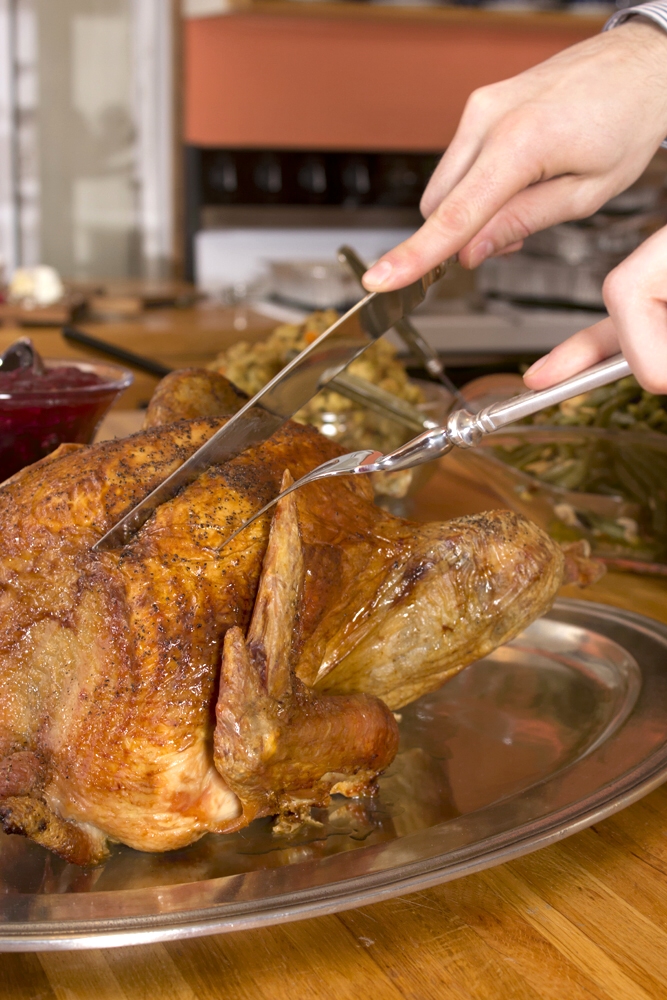
Set up before the bird reaches the board
Put a large, stable cutting board on a secure work surface, with a platter close by for the portions. A rim or juice groove helps contain liquid. Keep a carving fork in your non-cutting hand and use a sharp knife you can control. A long carving knife can make long breast cuts convenient; a chef’s knife is a useful alternative when that is the knife you know. Use either to cut meat and follow joints, not to chop through bone.
Remove the legs and wings at the joints
Place the turkey breast-side up with the legs toward you. Pull one leg gently away from the body and slice through the skin where the thigh meets the breast. Move the leg outward until the joint opens into view, then cut through the joint to free the leg and thigh together. If you want to serve them separately, bend the leg at the knee joint and cut there rather than forcing the knife through bone. Repeat on the other side.
Pull each wing away from the body and cut through its joint. The wings can go to the platter whole or be left for another use. If a cut meets hard resistance, pause and locate the joint again; the knife should pass through the joint, not through a bone.
Lift off and slice the breast
Find the breastbone running down the centre of the bird. Starting at its upper end, make one long cut down one side, keeping the blade close to the bone. Follow the curve of the rib cage with the knife tip and use controlled strokes to release the breast in one piece. Repeat on the other side. Taking each breast off whole gives you a steady piece to slice on the board, instead of trying to carve serving slices from a curved bird.
Set a breast portion on the board and cut it crosswise into serving slices with smooth strokes. Arrange the slices on the platter, then add the legs and wings. If a slice is thicker than you want, make the next one thinner; the first cut is a guide, not a fixed standard.
Keep the knife choice practical
A dedicated carving knife is useful if you regularly serve roasts and enjoy a long slicing edge. For one holiday bird, a sharp chef’s knife already in your kitchen can do the job. Choose a blade that is long enough for a comfortable stroke and familiar in your hand. The sujihiki vs carving-knife guide explains where a Japanese slicer and a table-side carver differ; neither should be used to cut through bone.
For leftovers, cut the turkey into smaller pieces and refrigerate them in shallow containers within two hours of cooking. USDA advises carving a cooked whole turkey before chilling because a whole bird does not cool as quickly. Check its leftover guidance for storage and reheating details.
Sources: National Turkey Federation, How to Carve a Turkey; USDA FSIS, Turkey from Farm to Table and Turkey Basics: Handling Cooked Dinners.