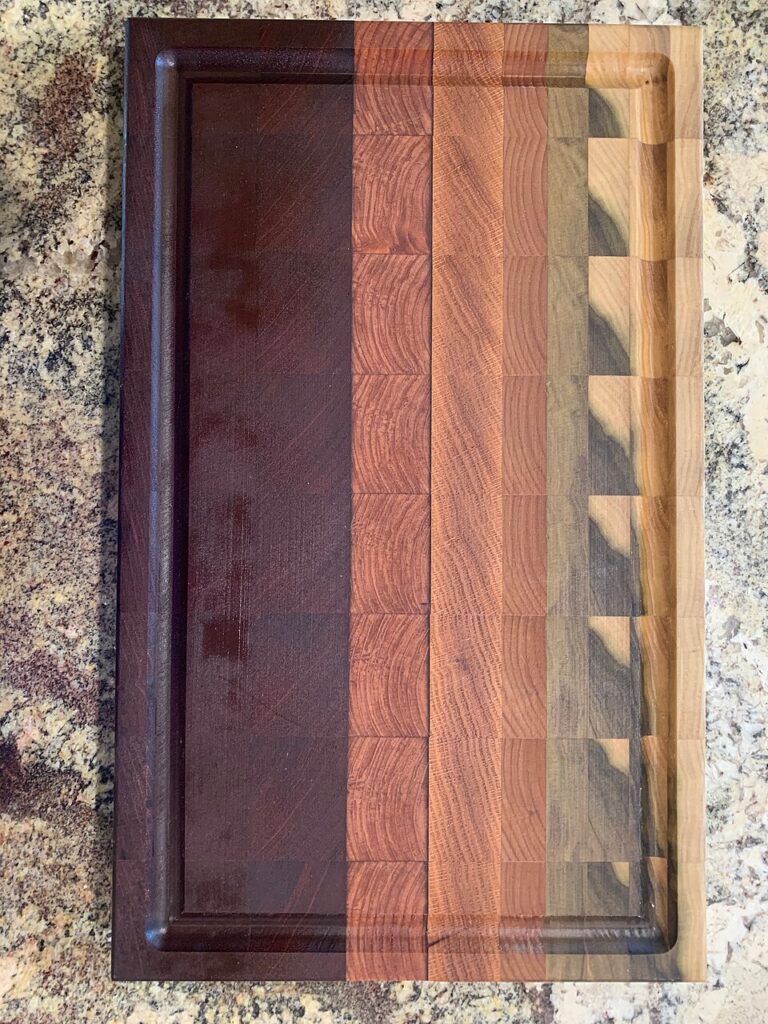
For a straightforward daily board, start with edge grain if a lower-cost, commonly available construction and simpler upkeep matter most. Choose end grain if you specifically want the block-style cutting face and are comfortable checking the individual board’s weight, price and oiling instructions. John Boos describes edge-grain boards as its more common, affordable option; its end-grain construction takes more work and may need more oiling. Treat those as maker guidance, then compare the actual model.
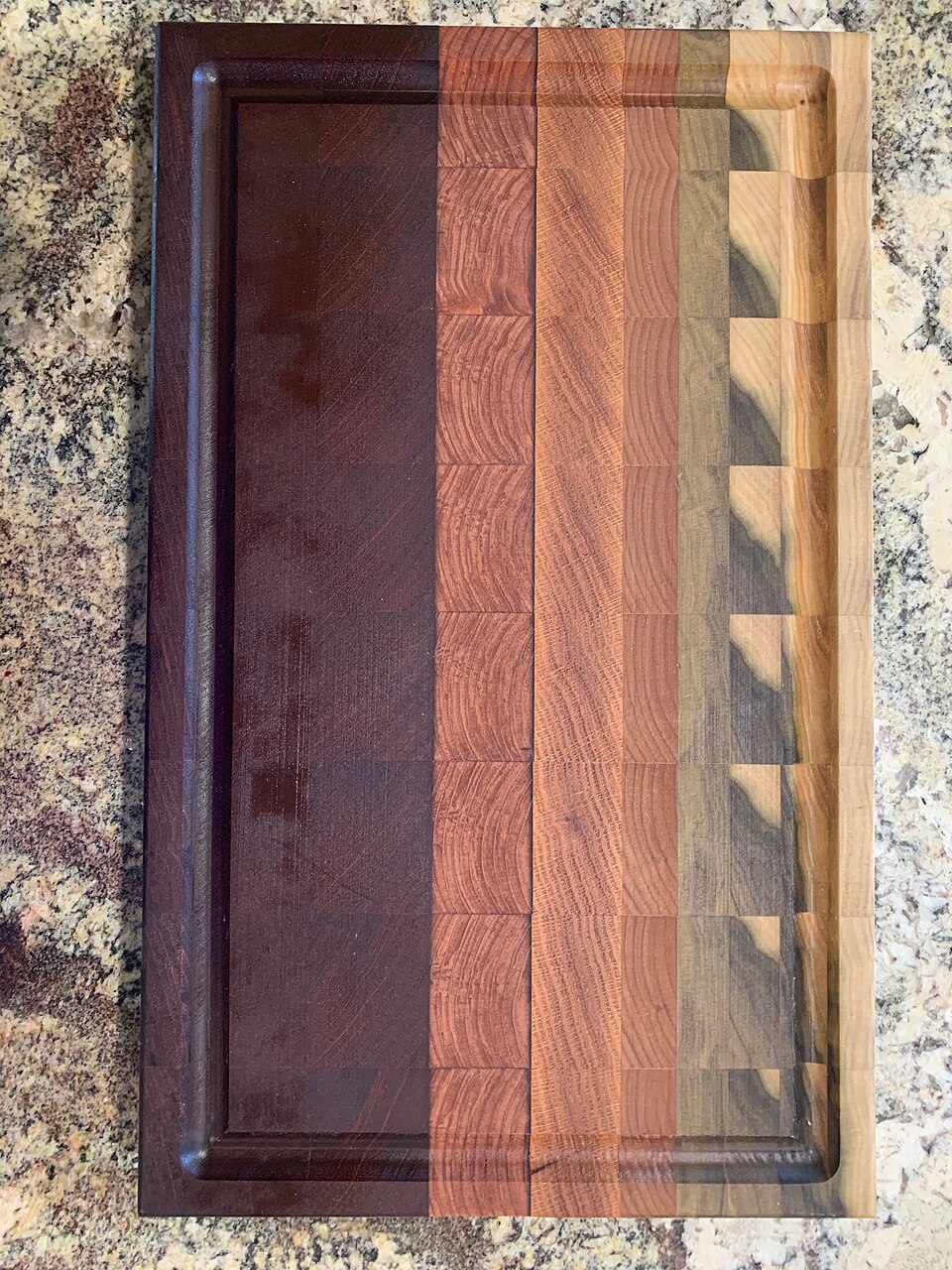
What the grain label means
An end-grain cutting face shows the short ends of the wood fibres. John Boos describes its end-grain boards as short rail pieces glued into a pattern. An edge-grain face shows the long sides of rails; its edge-grain boards use full-length rails. These are useful pictures of the maker’s construction, not a universal manufacturing specification. When a listing is vague, look for the maker’s construction description rather than guessing from a photo.
“Face grain” and “flat grain” refer to wood orientation too, but they are not synonyms for end- or edge-grain board assembly. The USDA Forest Products Laboratory glossary defines end grain as cut across the fibres and flat-grained lumber by the annual-ring direction relative to the sawn face. A board can be assembled in different ways from lumber with different ring orientation.
Compare the tradeoffs
| Edge grain | End grain | |
|---|---|---|
| Construction | Long rails run along the board; the cutting face shows their sides. | Short rail sections are turned so their ends form the cutting face. |
| Marks and knife claims | John Boos notes that visible knife marks can develop and describes sanding and oil/cream for refreshing its boards. | John Boos says its end-grain surface absorbs cutting impact; this is a maker claim, not a promise that marks disappear or knives stay sharp. |
| Price and care | John Boos describes its edge-grain boards as common and more affordable. Follow the chosen model’s wood-care directions. | John Boos says the more labor-intensive construction costs more and may need more oiling. Check the exact instructions. |
| Model check | Its walnut R-Board listing gives 18 × 12 × 1.5 in and 9 lb. | Its walnut CCB listing gives 20 × 15 × 2.25 in and 18 lb. |
The two John Boos examples differ in footprint and thickness, so their listed weights do not measure a grain-only weight difference. If you carry a board to the sink or store it upright, use the exact model’s weight and dimensions to decide whether it will be comfortable. Also check whether it is reversible, has feet or a juice groove, and what the maker says about washing and oiling.
For most daily kitchens, compare an edge-grain model first; choose end grain when its block-style surface and care routine suit you better. Both are wood boards: keep them dry between uses and follow their own care instructions.
For footprint examples and a counter, sink and storage fit check, see what size cutting board you need. For the broader question of which surface suits a Japanese knife, see cutting-board materials for Japanese knives. Explore more tools in the kitchen tools guide.
Sources: USDA Forest Products Laboratory glossary; John Boos end-grain vs edge-grain guide; John Boos FAQ; Walnut R-Board listing; Walnut CCB listing.