Choose the format before the material. A takoyaki pan can be a standalone stovetop pan, an accessory made to sit on a particular gas-cooker arrangement, or a removable plate for an electric appliance. Confirm that connection first. Then choose the number and size of wells you want to work with, and a pan you can lift, wash and store comfortably.
For an induction kitchen, begin with a model explicitly approved for induction. For tabletop cooking, decide whether you already own the required heater or are buying a complete appliance. A low price for a loose plate means little if the equipment that heats it is missing.
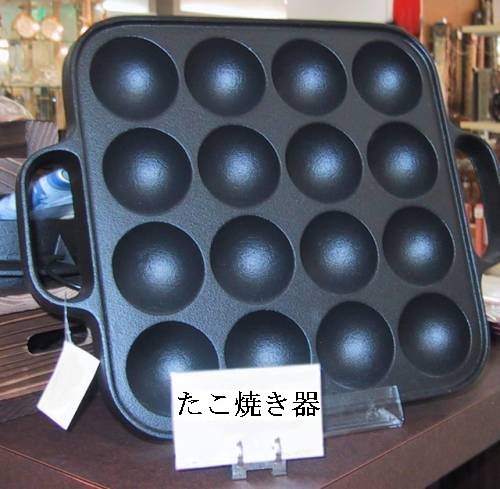
Three things sold under the same name
A pan is not always a complete cooking system. These manufacturer examples make the distinction concrete; they are not a ranking of which cooks best.
| Named product | Format | Important fit detail |
|---|---|---|
| Iwachu 24025, 23-hole pan | Cast-iron stovetop pan | Maker lists gas, direct flame and induction |
| Iwatani CB-P-TAF | Gas-cooker accessory | Underside indentations fit the intended pan supports |
| Zojirushi EA-YBC01 | Electric-griddle accessory | Requires the EA-BDC10 host appliance |
Iwachu’s product page, Iwatani’s accessory specifications and Zojirushi’s plate listing describe those particular connections. A pan that looks similar in a shop photograph need not have the same approval.
This distinction matters before comparing prices. If you already own a compatible electric griddle, an accessory plate may be a modest addition to the existing setup. If you own no host appliance, compare the complete purchase and its storage footprint with a stovetop option. Conversely, buying a separate appliance only for its pan may make little sense if you want to cook at the stove.
Induction, gas and electric plates ask different questions
With induction, find an explicit compatibility statement for the exact pan. The Iwachu example establishes that an induction-compatible takoyaki pan exists. It does not establish that every cast-iron takoyaki pan, or every model from the same maker, works on every hob. The cooktop’s cookware requirements still apply, including its accepted pan size and contact arrangement.
For a gas accessory, look underneath as well as at the wells. Iwatani describes shaped indentations that locate its accessory on gas-cooker supports. That is a designed connection, not permission to balance the plate on whichever burner happens to be nearby. Match the intended cooker and its instructions.
An electric accessory has another dependency. Zojirushi says the EA-YBC01 cannot be used on its own. Its instruction manual identifies the heater set, body guard and temperature-control plug supplied by the EA-BDC10. Check both model numbers when buying used equipment or a replacement plate; the word “Gourmet Sizzler” alone is not the full match.
Well count is also the amount of work in front of you
The number of wells tells you how many pieces a full batch contains. It does not tell you how large they are, how quickly they cook or how easy you will find the batch to manage. Iwatani lists approximately 40 mm wells for the CB-P-TAF. Zojirushi describes the EA-YBC01 as making 26 large pieces. Those are different kinds of specification, so do not silently turn one into a diameter comparison.
Takoyaki is formed by working and turning the batter in the wells; Iwatani’s instructions illustrate that process. As a buying judgment, consider whether you want to manage a large batch at once or work through smaller batches. More cavities are useful only when they suit the amount you want to make and the attention you want to give it.
For two people sharing an occasional snack, the largest advertised batch is not an automatic advantage. For a group who enjoy the cooking process together, a larger working surface may be appealing. These are examples of routines, not serving estimates: appetite, recipe and piece size determine how far a batch goes.
Cast iron and coated aluminum: read beyond the material name
Iwachu lists the 24025 at approximately 2.8 kg, with a cast-iron body and a silicon-baked coating. Iwatani lists an aluminum-alloy body with a nonstick interior for the CB-P-TAF. Those descriptions tell you what you will own; they do not constitute a measured comparison of browning, release or heating uniformity.
Weight is especially practical. Think about moving the empty pan from a low cupboard, washing it in the sink and drying it before storage. If lifting a heavy piece of cookware is already awkward, that deserves more weight in the decision than an attractive photograph of the finished food.
Treat the surface as a separate care question. “Cast iron” does not mean every first-use procedure is identical, particularly when the maker specifies a factory coating. “Nonstick” does not mean every utensil or cleaning method is acceptable. Find the actual first-use and care directions before adding oiling, seasoning or abrasive cleaning routines borrowed from another pan.
Plan the space around the pan
Compare overall dimensions, including handles or projecting parts, against the cooking area and cupboard. For a tabletop appliance, include the complete base and controls, room to work around the food, and the placement required by the appliance instructions. The plate’s cooking area is only one part of that footprint.
Then consider the sink. A removable plate can be easier to handle than a complete appliance, but removability does not itself establish that every part is washable in the same way. Zojirushi specifically describes the EA-YBC01 cooking plate as fully immersible. That statement belongs to the plate, not to its heater or control plug.
Cleanup is easier to assess before purchase if you can identify which parts come apart and what care each receives. A pan you cook with occasionally still has to be cleaned after every use; awkward storage and washing remain part of ownership even when the cooking itself is enjoyable.
A choice you can make before ordering
Write down the heat source or exact host appliance, the batch you want to manage, and where the complete tool will live. Use those three answers to eliminate incompatible formats before comparing finish, color or accessory bundles.
If a listing does not say whether the heater is included, or names a host unit you do not own, settle that point before purchase. Once the connection is right, choose the wells and handling that suit your actual meals. For other tools bought around a realistic use and care routine, see the kitchen tools guide.