A honesuki is Japan’s poultry-butchery knife. Its triangular profile is the job description: a stiff, pointed tip for working around joints, a strong, fairly straight edge for cartilage and skin, and little that does not serve the task. It goes around bone, not through it—a honesuki is not a cleaver. Whether you need one depends less on your knife collection than on your cooking. If whole birds regularly reach your board, its focused shape can make the work cleaner and more enjoyable. If they do not, it may be more specialist than useful.
The job it was built for
Breaking a chicken into useful parts is not mainly a matter of force. The real work is finding the natural separations in the bird: opening the skin between leg and body, locating the hip joint, cutting through cartilage, tracing the breastbone, and keeping the edge close to the ribcage so that meat stays on the portion rather than the carcass.
That is why a honesuki looks unlike a small chef’s knife. The point is narrow enough to enter tight spaces, while the triangular body carries plenty of steel behind it. The knife feels deliberate rather than delicate. It can probe for a joint, turn against cartilage, and ride along the flat of a bone without the flexible, wandering sensation of a narrow filleting knife.
The distinction between working around bone and cutting through it matters. A honesuki can contact bone during careful butchery, but its edge is not made for chopping through leg bones, wing bones, or a carcass. That is cleaver work. Striking hard bone with a honesuki risks chipping the edge and then blaming the knife for being used outside its job.
Think of the bird as a set of seams rather than a structure to be hacked apart. The honesuki is shaped to find and open those seams.
Following the honesuki through the bird
Freeing the leg
The first useful movement is often a draw through the skin between the breast and thigh. Here the comparatively straight edge earns its place. Instead of asking a deeply curved belly to make contact along a short section, the honesuki lets more of the edge draw cleanly through skin and the thin tissue beneath it.
As the leg is eased away from the body, the knife does not need to make a broad chef’s-knife stroke. The tip can follow the visible line where the thigh meets the carcass, making small, controlled cuts while the other hand creates tension. The triangular profile keeps the heel from becoming the centre of the action; the working end remains the compact, pointed front of the blade.
Finding the hip joint
Pulling the leg outward exposes the hip joint, but the exact opening can still be less obvious to a first-time butcher. This is where the point becomes more than a visual signature. It can enter the pocket around the joint and help reveal where the bones articulate.
Once the joint is flexed or popped open, the edge cuts the connective tissue and cartilage holding it together. There should be no need to chop through the ball or socket. The stiffness immediately behind the point gives useful feedback: the blade feels supported as it turns and works through the joint rather than bending away from it.
That stiffness also helps when the edge touches the outside of a bone. Instead of sawing across it, the blade can be angled to follow its surface. The bone becomes a guide. A controlled pass releases meat while leaving the hard structure intact.
Taking the wing
The wing presents another compact joint surrounded by skin and connective tissue. A chef’s knife can do the job, but its broader tip may obscure the small space being opened. The honesuki’s point makes the separation easier to read.
The edge first draws through the skin, then the tip searches for the soft gap in the joint. Once that gap is found, very little pressure is required. The knife is strongest when it follows the anatomy: point into the opening, edge through the connective tissue, bone left uncut.
This is also where misuse can become tempting. A wing joint that has not been properly exposed can feel like an obstacle to overpower. With a honesuki, resistance is a reason to change the angle or flex the joint again—not a reason to swing harder.
Lifting the breast from the ribcage
Removing the breast shows a different side of the same design. The point begins the cut beside the breastbone and traces the structure beneath the meat. The stiff blade can then ride along the ribcage with its face close to the bone, separating meat through a series of short, guided cuts.
The triangular form places strength behind the tip during this work. It does not feel like a fragile needle attached to a larger blade. At the same time, the blade has enough height toward the heel to leave grip room when the carcass is resting close to the board.
This is not slicing in the usual sense. There is no need for a long, sweeping stroke. The bird is being opened along its contours, with the knife moving only as far as the next visible or tactile landmark. The honesuki’s value lies in making those compact movements feel natural.
Beyond poultry, honestly
Some cooks use a honesuki as a sturdy utility knife. Its firm tip can open packaging, trim meat, portion small boneless cuts, or handle jobs that would feel too robust for a fine, narrow blade.
That versatility has limits. A honesuki is stiff and pointed, not a long slicer, and its comparatively straight profile is not designed for the rhythmic board work expected of a vegetable knife. It can cut vegetables, of course, but that does not make it the most comfortable choice for preparing a pile of them.
Its edge is also often ground asymmetrically, with traditional versions shading toward single-bevel construction, so its cutting feel may differ from that of a familiar double-bevel chef’s knife. The useful question is not whether a honesuki can perform other tasks. It is whether those tasks benefit from the same stiffness, point control, and compact edge that make it effective around a bird.
Do you need one?
If whole birds are occasional, the main knife already in the kitchen will manage; understanding gyuto vs santoku may matter more, while knowing what a petty knife is for reveals another capable in-hand alternative for smaller joint work. A sharp edge, a stable board, and patience are more important than owning a specialist shape.
If whole chickens, ducks, or similar birds appear every week, a honesuki can mark the difference between managing the job and enjoying it. The point finds the joints, the stiff triangular blade follows bone confidently, and the straight edge deals neatly with skin and connective tissue. Most examples are typically around 150 mm long, though proportions vary.
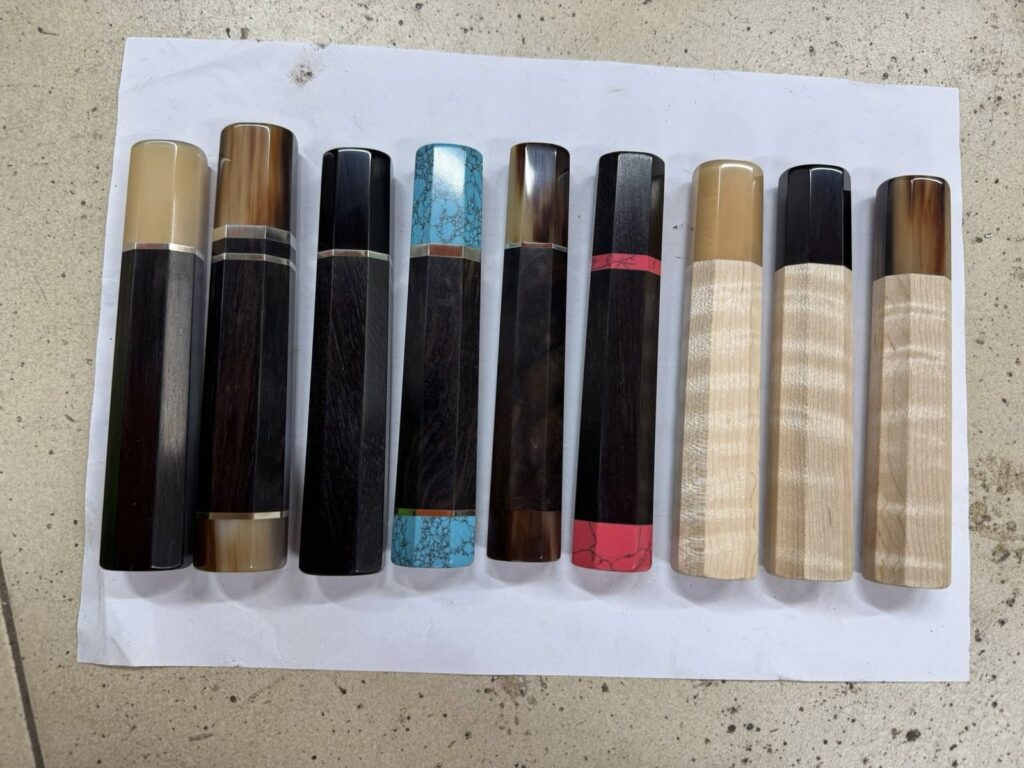
Honesuki are usually wa-handled, which is where we come in: Horn & Grain makes Japanese knife handles to order, while the anatomy of a Japanese knife provides useful context for how blade, tang, machi, and handle meet.