“Hand-forged,” “hand-finished,” “handmade,” and “artisan” are process descriptions of very different strength. Most of these English terms carry no certification unless a listing identifies one. Japan’s METI Traditional Craft designation is the one claim here with published criteria, though it certifies a defined craft process, not knife quality. Modern hand-forging normally includes power hammers; the smith controls the work, and mechanized force is standard smithing, not a scandal. Rank claims by specificity: who, where, and which step. Specific information tells you more than evocative language.
Why are these words slippery?
The problem is scope. “Handmade” might cover nearly the whole tool, one decisive operation, or only the finish. “Artisan” might describe a workshop’s scale, a person’s skill, or simply the tone of the collection. “Hand-forged” names one manufacturing stage but says nothing about sharpening or assembly. “Hand-finished” tells you even less about what happened earlier.
Most listing copy uses ordinary marketing English rather than the vocabulary of a named certification scheme. If no standard, certifying body, or designation is identified, the phrase stands as the maker’s or seller’s own process description. That does not make it meaningless. It means its resolution is low until the listing explains the work behind it.
This is an absence-of-certification point, not a survey of what any word legally means. The practical question is simpler: what verifiable detail travels with the claim?
Which claim comes with published criteria?
The useful exception is Japan’s Traditional Craft designation, administered by the Ministry of Economy, Trade and Industry. METI’s Article 2 note publishes five criteria. Among its exact wording, a craft must be “hand-crafted for the majority of the manufacturing process” and “manufactured using traditional technologies or techniques.” The full list is public and belongs to a named designation rather than to a mood or style.
The Association for the Promotion of Traditional Craft Industries identifies both Sakai Uchihamono and Echizen Uchihamono—Sakai and Echizen forged blades—as designated crafts. Its listings name the production areas, products, materials, and specified techniques. They offer a firmer reading than the unqualified word “traditional.” For more context on what a production place can and cannot tell you, see Japan’s knife towns.
The designation applies to a defined regional craft and its criteria. It is not a test of whether a particular knife cuts better, suits a particular cook, or exceeds an undesignated tool. Read it as evidence about process and provenance, not as a quality guarantee or a ranking.
What can “hand-forged” plausibly denote?
Used accurately, “hand-forged” says that a smith shapes heated metal through hammering. It does not promise that every blow comes from an arm-held hammer. The Association’s Echizen process description includes a belt hammer for quickly flattening stacked pieces, followed by lighter hammer work for straightening and shaping.
That is a useful picture of modern hand-forging. A power hammer supplies repeated force; the smith controls the heat, position, angle, timing, and sequence of the work. Mechanized force and hand control are not opposites. Power hammers are normal smithing equipment and do not cancel the human control described by the claim.
The phrase still has boundaries. It does not identify who performed the forging, where it happened, whether one person completed the whole tool, or how later grinding and sharpening were done. A stronger listing names the smith or workshop and describes the forged step.
What do “hand-finished” and “hand-sharpened” denote?
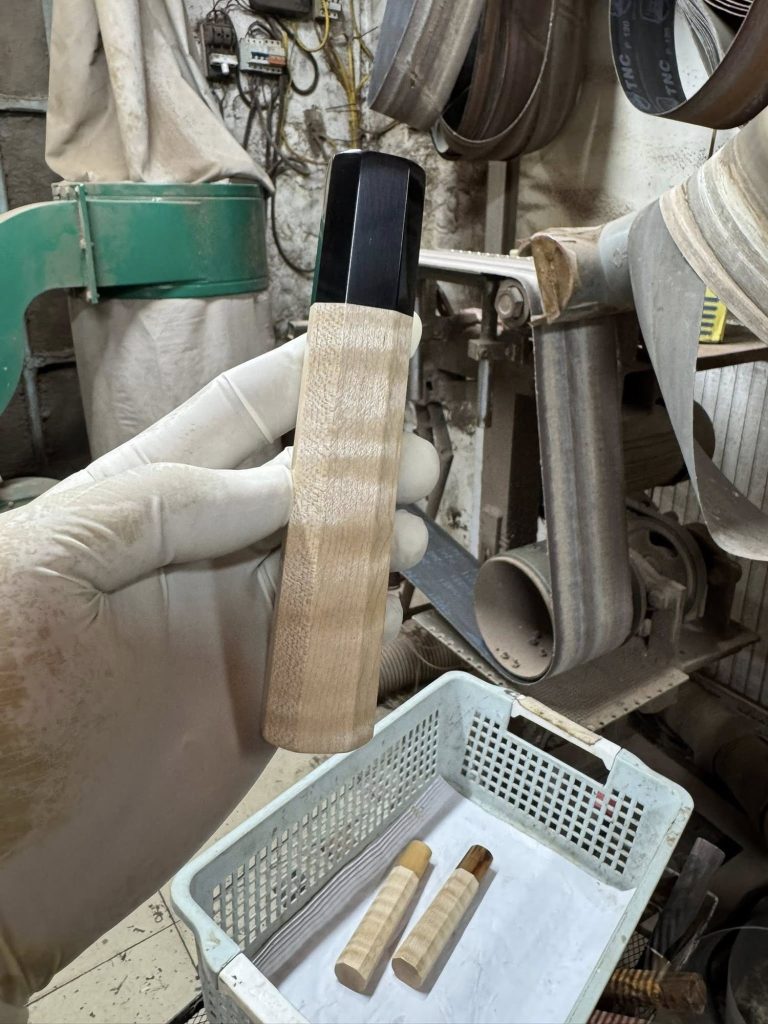
These are narrower claims, and that narrowness can make them useful. A factory-made blank can be cut, formed, and hardened with production equipment, then ground, straightened, polished, or sharpened by a person. “Hand-finished” accurately describes those final operations; it does not reach backward and turn the blank into a hand-forged object.
“Hand-sharpened” also need not mean that every pass was made on a small unpowered stone. A person may guide the blade on powered grinding or polishing equipment and finish it on a whetstone. The Association’s Sakai process account places hand sharpening and finishing within a sequence that also uses large electric sharpening equipment.
Mixed production of this kind is common and legitimate. The hand work may matter greatly to the final edge or surface. The phrase is worth exactly what it says: a claim about the finishing or sharpening step, not the whole manufacturing chain.
What do “artisan” and “handmade” add?
“Artisan” and “handmade” are the weakest claims because they are register words before they are precise process records. They signal craft, care, or small-scale identity, but alone they do not tell you which hands did what.
Stronger listings add particulars:
- a named maker or workshop, with the person’s role;
- a named operation, such as forging, grinding, sharpening, polishing, or handle making;
- a named place of production, with the official designation identified when relevant.
A region name is useful context, but it is not a substitute for a process description. A maker’s name is useful too, but only when the listing makes clear what that person did. Specific nouns and verbs carry more information than a stack of craft adjectives.
How can you read a listing without cynicism?
Treat the copy as an evidence ladder. A named person doing a named step in a named place is stronger than a place alone. A step-specific claim such as “hand-sharpened” is stronger than “handmade” because its scope is visible. An official designation is strongest when the listing connects the actual item to the named craft and its published criteria.
Ask three questions in order:
1. Who? Is a maker, workshop, or specialist identified, and is the role clear? 2. Where? Is the place tied to making, finishing, or merely the wider identity of the object? 3. Which step? Does the claim refer to forging, finishing, sharpening, assembly, or the entire tool?
Keep anything unanswered in the “unknown” column. Vague wording is absent information, not proof of deceit. A short or translated listing may simply leave details out. The disciplined response is neither belief nor suspicion; it is to avoid adding a story the listing has not supplied.
The deeper question—does handmade even matter?—belongs with Japanese kitchen craft. This page’s narrower job is to turn that larger question into a practical reading habit: give each word exactly the weight its specificity can carry.