Thuya burl can suit a bunka without looking or feeling oversized, but the knife—not the wood name—must set the handle’s volume. Start with grip proportion, pinch-grip clearance and the balance you want; let the figure occupy that shape rather than enlarging the handle merely to display more burl.
Set the bunka’s proportion first
The wa-handle size guide uses knife type and blade length only as starting evidence for outer proportion. Actual fit still follows the individual knife. A compact bunka does not automatically require one fixed handle size, and a larger bunka does not justify increasing every dimension without considering the user’s grip and the blade’s balance.
Choose a comfortable cross-section and sufficient pinch-grip clearance before deciding how much figured surface to show. Dense material can move the balance rearward when other factors are equal, but density alone cannot predict the weight or balance of an untested finished thuya handle.
What the burl research can—and cannot—tell us
Original research by Shukla and Kamdem examined Moroccan Tetraclinis articulata burl specimens with random grain texture, dark-brown oily surfaces and a dense microstructure. The findings support allowing for variable figure and possible rear mass. They do not establish the weight, origin, fit or water resistance of an untested handle blank.
Keep figure and accents in proportion
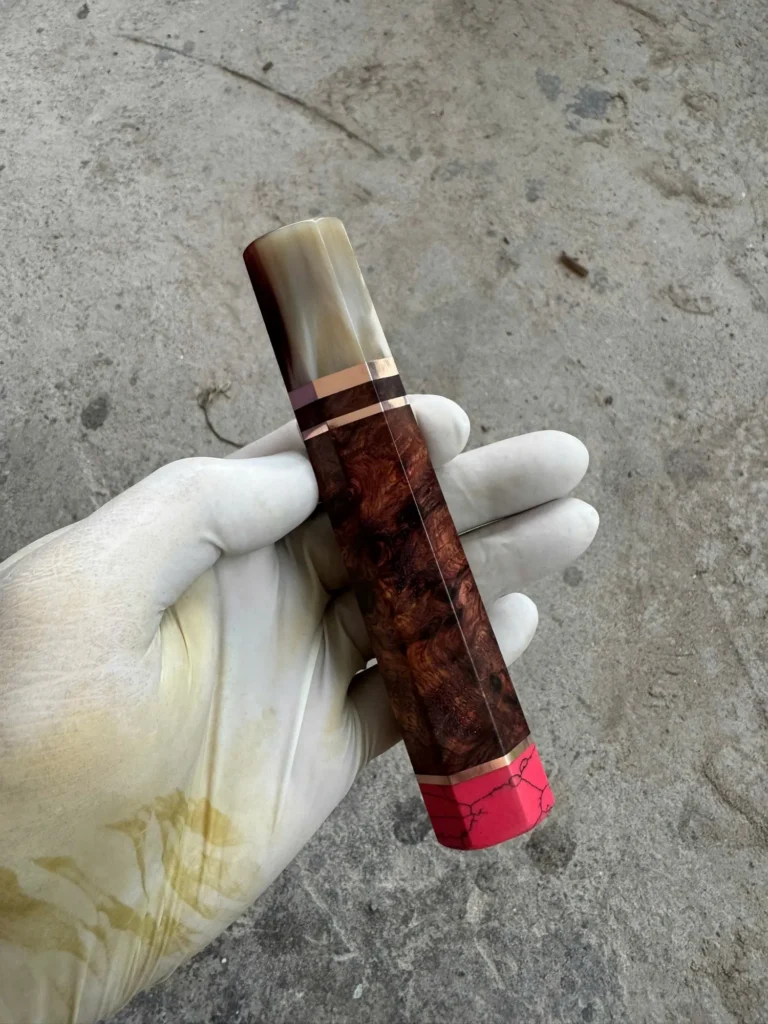
A visually active burl can carry the design on its own. A metal end cap, several contrasting accents or an enlarged body are optional aesthetic choices, not durability requirements. A quieter front section may give the figure more space; a stronger contrast may make the handle’s front boundary more prominent.
Thuya burl is not currently among the materials listed in the H&G catalogue or configurator; the current wood guide shows the established choices. This article is therefore proportion guidance, not a stocked-thuya offer.
If the existing handle is secure, leave it installed: visible junction height and thickness are only partial evidence. When the tang is already exposed, the three primary measurements in millimetres are usable length from shoulder or seating line to tip, height near the shoulder, and face-to-face thickness at the same station.