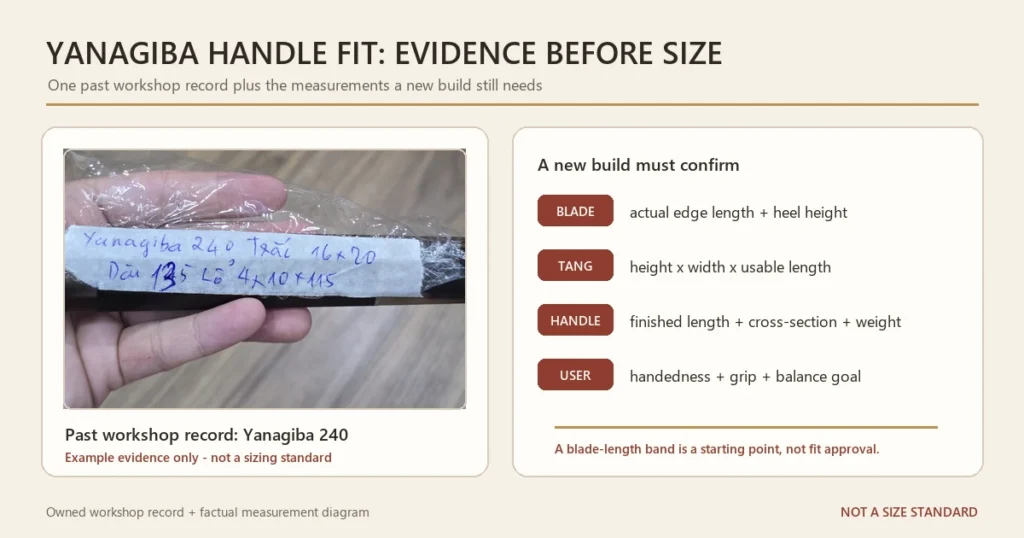
Short answer: use blade length only to choose a starting neighborhood. A 240 mm yanagiba may begin around a 130–145 mm handle; a 270–300 mm blade often starts around 140–150 mm or longer. These are planning bands, not specifications. A recommendation still needs the tang, blade height, handedness, existing handle, balance goal, and proposed handle’s finished measurements.
Starting length only
- About 240 mm: explore roughly 130–145 mm.
- 270 mm and longer: explore roughly 140–150 mm or more.
- Keep the front cross-section compatible with the tang, heel clearance, and grip.
- Adjust from the present knife rather than from blade label alone.
Yanagiba-specific inputs
- Right- or left-handed single-bevel blade.
- Actual edge length, blade height at heel, spine thickness, and total weight.
- Tang width, height, taper, usable length, offset, and intended insertion depth.
- Long-pull control and the balance change the primary user wants.
Evidence limit
- Horn & Grain does not currently publish individual finished dimensions and weights for these proposed yanagiba handles.
- The configurator’s XL 270–360 mm choice is a blade-length pricing band, not a handle-dimension promise.
- Ask for actual-piece measurements before approving the build.
Why yanagiba size cannot be reduced to one ratio
A yanagiba is a long, narrow slicer traditionally used for fish. Japanese Knife Imports describes true yanagiba as single-bevel: one face carries the primary grind and the other has a hollow ura. That construction is handed, and its use and sharpening differ materially from a Western or double-bevel knife. Handle selection therefore begins with the actual right- or left-handed blade and primary user, not with a generic “slicer” label.
Length matters because the blade creates leverage ahead of the hand, but thickness, taper, blade height, tang geometry, total mass, insertion depth, and grip also change the result. Two 270 mm yanagiba can need different bores and feel different with identical outside handle dimensions.
Maker examples show the spread. Hitohira lists 240, 270, and 300 mm wa-handle yanagiba samples with 135, 140, and 145 mm handles; another 270 mm product lists 138 mm. These complete knives are not Horn & Grain prescriptions, and Hitohira says sample measurements can vary.
Starting bands for 240, 270, and 300 mm blades
Horn & Grain’s guide starts 240 mm longer blades at 130–145 mm and blades of 270 mm or more at 140–150 mm or longer. Compare those ranges with the present knife. They must not override an incompatible tang or a proven handle.
- Around 240 mm: explore 130–145 mm, staying restrained for a light blade, compact grip, or forward-balance goal.
- Around 270 mm: explore 140–150 mm, then check existing proportions, tang insertion, and finished mass. It is not a minimum.
- Around 300 mm: explore 140–150 mm or longer without automatically maximizing length or rear weight.
The broader Horn & Grain table groups deba and yanagiba together across 165–300 mm because both require task-specific checks; do not copy its entire combined cross-section envelope onto every yanagiba. A heavy deba and a long slender slicer do different work. Ask for the proposed ferrule and butt height and width for your particular blade.
Measure the blade, height, and tang
Record nominal size and actual edge length, explaining how you measured. Add heel height, spine thickness near the handle, total weight, current handle dimensions, and balance point. Side and choil photographs show whether a large ferrule could crowd the grip or reduce clearance. Blade height is an input, not a formula.
If the handle remains securely installed, photograph the knife rather than removing it just to expose the tang. If the tang is already bare, measure width and height near the shoulder and again farther back, usable length, taper, any offset from the blade centerline, and the condition of the steel. State whether the old fit was burned in, bonded, loose, or previously repaired. Use the Horn & Grain size guide to label outside measurements consistently and the ordering guide to prepare photographs.
A long blade magnifies poor alignment. Bore dimensions, insertion depth, and the ferrule seat must suit the actual tang so the spine and edge can be aligned through the handle. Do not force a large, crooked, corroded, or offset tang into a generic opening. If the fit or old attachment is uncertain, a qualified installer should assess it.
Single-bevel handedness changes the brief
Specify blade and user handedness even with a symmetrical handle. Octagonal or oval profiles do not make a right-handed blade left-handed. A D-shape adds a palm reference and must use the intended orientation; Horn & Grain’s configurator explicitly asks for it.
Do not infer blade handedness from a product photograph. Send clear images of both faces and identify the maker and model. If the buyer is new to single-bevel knives, the handle order should not imply that a new grip solves the technique and sharpening differences. Japanese Knife Imports specifically treats first-time single-bevel ownership as a category that merits additional guidance.
Finished handle weight and long-blade balance
A yanagiba can feel forward, but “add the heaviest wood” is not a solution. Some users want rear presence; others prefer a forward cue for a long pull. Describe a controlled change from the current knife instead of claiming one correct balance point.
For every candidate, request the finished handle’s weight, length, ferrule and butt dimensions, materials, bore depth, and end details. Horn, spacers, metal rings, end caps, cross-section, taper, and removed material all change mass. The assembled weights on external knife listings cannot be subtracted into a trustworthy handle weight because the bare blades and insertion details are not published as matched measurements.
Horn & Grain’s current public yanagiba content and configurator do not publish an individual finished handle weight or full outside dimensions for the buyer’s proposed piece. Obtain them by sending the knife details through the configurator or contacting Horn & Grain, then ask for the planned dimensions and finished-weight target in the order confirmation. Until those numbers exist, describe the intended direction—preserve forward feel, move slightly rearward, or copy the existing balance—without promising a result in grams or millimeters.
Grip shape and cross-section
Octagonal facets give an orientation cue. Oval spreads palm pressure. D-shape supplies a fixed reference but is orientation-specific. None is categorically best; prefer a shape the primary user already controls comfortably.
Describe where the grip happens. A blade-led pinch grip may favor a restrained ferrule, while a user who holds farther back may care more about butt volume and length. State whether the current handle rotates, pinches the middle finger, runs short under the little finger, or feels too large near the blade. A hand measurement without these observations cannot settle cross-section.
Materials, finish, and extra-long builds
Choose materials after the fit and weight brief. Dense woods and end components can add rear presence, but only the finished measurement shows how much. On an extra-long handle, small increases in mass placed near the butt can have a noticeable effect on feel because they sit farther from the blade. That is a reason to request measurements, not a reason to ban dense woods or end caps.
Confirm the actual blank and natural ferrule because figure and horn color vary. Ask what finish will be applied and follow its care instructions. Keep the handle out of standing water and the dishwasher, and dry the ferrule and blade junction promptly. A loose tang, widening gap, split ferrule, swelling, or corrosion needs inspection; do not hide it with oil or an improvised adhesive repair.
Yanagiba order checklist
- Maker, model, nominal and measured blade length, blade height at heel, spine thickness, both blade faces, and right- or left-handed grind.
- Current handle length; ferrule and butt width and height; shape; and what the primary user wants changed.
- Current total knife weight and balance point, with one clear target such as “keep a modest forward cue.”
- If exposed: tang width, height, usable length, taper, offset, condition, and intended insertion depth. If hidden: side, spine, choil, ferrule, and handle-end photos.
- Primary user’s handedness, grip position, shape preference, and experience with single-bevel knives.
- For the proposed handle: exact finished length and cross-section, finished weight, bore plan, materials, actual-piece photo, finish, and installer.
Review the installation guide to understand the fit questions, but do not treat a long, sharp, single-bevel knife as a trial installation. Protect the edge and use an experienced fitter when removal, tang condition, bore adjustment, or alignment is uncertain.
Evidence reviewed 8 August 2026. Horn & Grain ranges are planning ranges rather than standards, compatibility promises, or published individual-handle measurements. Hitohira specifications are sample measurements of complete knives, not Horn & Grain build data. No unpublished handle weight, universal balance point, guaranteed fit, or conversion from the configurator’s blade-length pricing band is inferred.
Sources and fit references
- Horn & Grain: Wa Handle Size Guide by Knife Type and Blade Length
- Japanese Knife Imports: wa-handle and single-bevel knife guidance
- Hitohira: 240 mm yanagiba sample specifications
- Hitohira: 270 mm yanagiba sample specifications
- Hitohira: 300 mm yanagiba sample specifications
- Horn & Grain: Custom Wa Handle Ordering Guide
Configure a yanagiba handle from the actual blade, tang, handedness, and balance brief