The safest way to investigate an uncertain line is to create a repeatable visual record, not to test the line physically. One inspection may show grain, a finish boundary or a genuine opening; comparable photographs reveal whether the feature is new or changing without claiming that sight alone proves the handle safe.
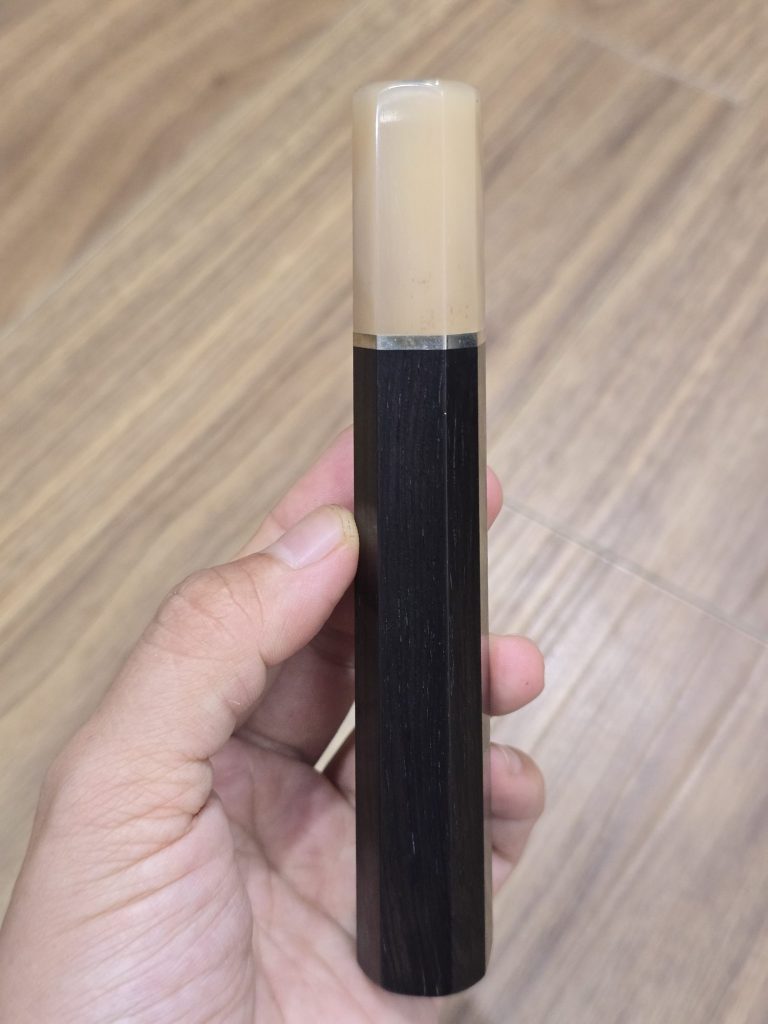
Make photographs comparable
Begin when the handle’s surface is dry after ordinary care. Use diffuse light, a plain background and the same viewing angle each time. Photograph the full handle for orientation, then take close views of the line and the front junction from more than one face.
Record the date, the line’s location and whether it reaches an edge, ferrule, tang opening or wood-to-horn seam. A ruler may sit beside the handle as a scale, but do not mark the finish. Note recent storage conditions or unusual water or heat exposure so later photographs have context.
Never wet the line to make it visible, and do not scratch, probe, sand or flex it. Those actions can change the very feature being observed.
Compare the feature, not the lighting
A line that retains the same path and appearance under matching conditions may be an unchanged grain or finish feature, but that observation is not a safety certificate. Retake photographs if glare or shadow makes the comparison uncertain.
Treat these as meaningful changes to document:
- a line appearing where none was recorded;
- extension, branching or visible opening;
- lifted edges or material loss;
- a new ferrule or front-junction change;
- blade or handle movement that has already occurred.
Environmental context matters because wood exchanges moisture with its surroundings. The USDA Forest Products Laboratory’s Wood Handbook chapter on moisture identifies humidity, temperature and the wood’s existing moisture as influences. That supports recording conditions, but it does not supply a universal humidity target or internal drying time.
When observation is no longer enough
Move to the crack-triage guide when the line is new or changing, material has detached, or movement has appeared. Sakai Ichimonji notes that cracks or ferrule damage can admit moisture around the tang and that resulting corrosion may affect repairability. An exterior photograph cannot reveal that hidden condition.
For routine prevention without invasive inspection, follow the wa-handle care guide.