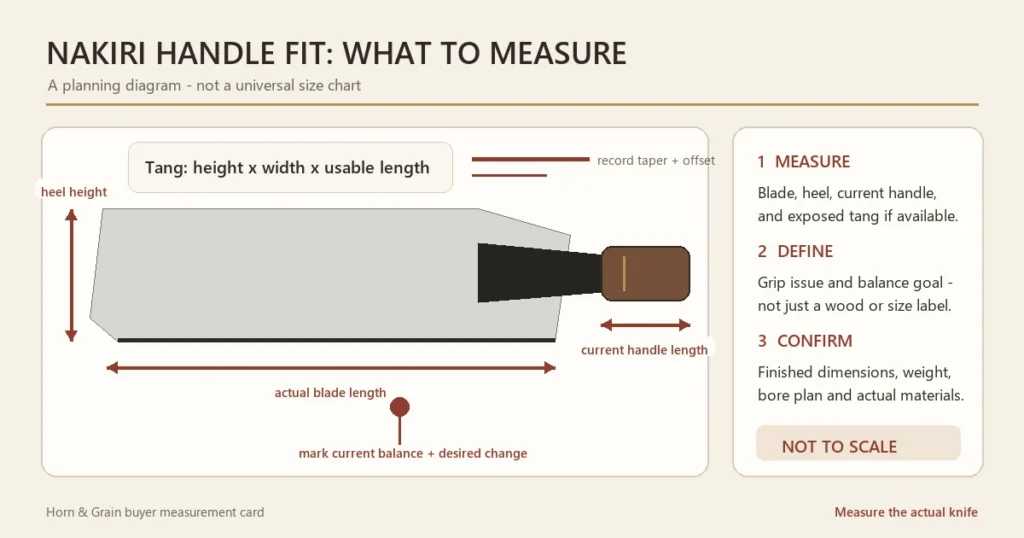
Short answer: for many 165–180 mm nakiri, start the conversation around a 115–125 mm wa handle with a restrained cross-section. This is not a fit guarantee. The bore must fit the actual tang, the finished weight must support the intended balance, and the shape must orient the edge without crowding the grip. Measure before choosing materials.
A conservative starting point
- Blade: 165–180 mm nakiri.
- Handle length: 115–125 mm.
- Ferrule face: about 17–19 mm wide by 21–23 mm high.
- Butt: about 19–21 mm wide by 23–25 mm high.
What can change that start
- Actual tang height, width, taper, length, and intended insertion depth.
- Blade height, thickness, total knife weight, and present balance point.
- Pinch grip versus a handle-led grip, hand size, and shape preference.
- The finished handle’s measured mass—not a wood trade name.
Do not order from
- Blade length alone.
- A claim that every nakiri uses a “medium” handle.
- Wood density without the candidate handle’s dimensions and weight.
- A photograph that does not show the actual piece or the knife’s tang.
Why a nakiri needs its own handle decision
A nakiri is a double-bevel vegetable knife with a broad, relatively flat-edged blade. Sakai Ichimonji Mitsuhide describes the category as a 160–180 mm vegetable knife designed to contact the board from heel to tip. That geometry makes the heel, edge direction, and hand-to-board clearance especially relevant. A handle that feels acceptable on a narrower knife can feel bulky behind a tall nakiri blade or can put too much mass behind a short cutting edge.
Blade height is not a handle-size formula. It is a prompt to inspect the whole grip. Record height at the heel, then photograph the knife from the side and from the choil. Check where your knuckles sit in a normal pinch grip and where your last two fingers contact the handle. The goal is comfortable clearance and an immediately readable edge direction, not the largest cross-section that can be fitted.
Published knives illustrate why one “standard” is unreliable. A Hitohira 165 mm nakiri sample lists a 50 mm blade height and 125 mm octagonal handle; a product labeled 180 mm lists a 52 mm blade height and 133 mm handle. These complete knives are not Horn & Grain prescriptions, and their listed weights are assembled-knife weights. They show only that a blade label does not mandate one handle length.
Measure the blade and tang before choosing a handle
If the present handle is secure, do not remove it merely to fill out an order form. Measure the blade from heel to tip, blade height at the heel, current handle length from ferrule face to butt, and the current ferrule and butt height and width. Mark the present balance point by carefully supporting the knife with the edge protected, and describe whether you want that point to stay where it is, move slightly toward the handle, or remain blade-forward.
If the tang is already exposed, record its usable length, width, and height near the shoulder and again farther back, plus any taper, offset, corrosion, bend, machi gap, or previous adhesive. A hidden tang is three-dimensional; one width measurement cannot describe the mortise it needs. Add clear side, spine, choil, and end-on photographs with a ruler in the same plane. Horn & Grain’s wa handle size guide explains the outside dimensions, while the custom ordering guide lists the information to send.
Fit is more important than decoration. The opening must allow controlled fitting, adequate insertion, and straight blade alignment without forcing the ferrule apart. An unusually short, thick, tapered, off-center, repaired, or damaged tang needs an individual assessment. “Fits a standard wa tang” should never be treated as a dimensional warranty.
How to use the 115–125 mm starting band
The 115–125 mm range and the cross-sections above come from Horn & Grain’s current planning guide for 165–180 mm santoku, nakiri, and bunka. Start near the restrained end when the blade is thin and light, the present knife already feels agile, the user pinch-grips close to the heel, or the proposed wood and end details make the finished handle comparatively heavy. Explore the other end only when hand fit, the existing proportions, or a measured balance goal supports it.
Do not scale every dimension together automatically. A buyer may need a little more length without a taller ferrule, or a fuller butt while keeping the front slim. An octagonal profile is measured across flats; an oval with similar maximum dimensions distributes pressure differently. Ask for a drawing or the intended ferrule and butt measurements when cross-section matters, rather than ordering “medium” and expecting every maker to mean the same thing.
Finished weight decides balance—not the wood name
A nakiri’s tall blade can carry noticeable forward mass even though the edge is not long. Some cooks like that forward cue during vegetable prep; others want the new handle to move the balance slightly back. There is no universally correct balance point. What matters is naming the change from the knife you already know.
Request the candidate handle’s finished weight, length, ferrule dimensions, butt dimensions, materials, bore depth, and end-cap details. Horn, spacers, metal rings, end caps, taper, and the amount removed for the tang all affect the result. “Walnut is light” or “ebony is heavy” may describe a broad material direction, but neither statement supplies the grams of the finished piece. A compact dense-wood handle can weigh less than a larger multi-part build in another wood.
When exact candidate measurements are not available, keep the balance claim modest: ask the maker to preserve a nimble, slightly blade-forward feel or to add only a little rear presence, then confirm the plan before work begins. Do not promise that a handle alone will place the balance at a particular spot without the blade, tang, insertion depth, and finished-handle measurements.
Octagonal, oval, or D-shape for a nakiri?
Octagonal is a strong default when the user wants crisp indexing: the facets help identify edge orientation before the blade reaches the board. Oval can spread pressure more softly during a long prep session, but its gentler reference may be less obvious to someone who relies on facets. D-shape adds a fixed palm reference and must be ordered for the primary user’s handedness. It is a preference, not an automatic upgrade for a double-bevel nakiri.
Choose from real grip information. Note whether the thumb and index finger stay on the blade, whether the middle finger meets the ferrule, whether the little finger runs out of room, and whether the current handle rotates when wet. If possible, provide the current handle dimensions and say exactly what feels too short, thick, angular, or vague. Hand size alone is less useful than that comparison.
Material, ferrule, and care come after fit
Select the material direction after the size and balance target are clear. A visually quiet, restrained build often suits a nimble nakiri; a denser or more elaborate build can also work when its measured mass supports the intended feel. Confirm the actual blank, ferrule, and end components because natural color and figure vary. Do not assume a premium name improves grip, stability, or fit.
Ask what finish will be applied. Keep natural wood out of the dishwasher and standing water, avoid soaking the grip, and dry the ferrule and blade junction promptly. Follow the maker’s care instructions. Oil cannot repair movement, a widening gap, swelling, a crack, or a sour odor; those signs call for inspection.
When custom sizing is justified
Custom sizing is most valuable when the current handle causes a specific grip problem, the tang falls outside the proposed bore, the knife has been repaired, the blade is unusually tall or heavy for its nominal length, or the balance needs a measured change. It is also justified when a user needs a handed D-shape or a cross-section copied from a handle that already works well.
If the knife is comfortable and secure now, copying its proven length and front/rear dimensions can be safer than replacing them with an internet average. If the tang condition or removal method is uncertain, use a qualified installer. The installation guide is a planning reference, not a reason to force a resistant tang, split a ferrule, or use uncontrolled heat.
Nakiri order checklist
- Maker, model, nakiri blade length, blade height at heel, spine thickness near the handle, and photos of both faces.
- Current handle length plus ferrule and butt width and height; describe what feels good or wrong.
- Tang width, height, usable length, taper, and condition if exposed; otherwise send side, spine, choil, and end photographs.
- Current knife weight and balance point, plus one requested change such as “preserve blade-forward agility.”
- Primary grip, hand orientation, preferred shape, and any pressure or rotation issue.
- For each candidate: finished dimensions, finished weight, bore/insertion plan, exact materials, actual-piece photograph, and finish.
Evidence reviewed 8 August 2026. The size bands are Horn & Grain planning ranges, not standards or compatibility promises. External product specifications are sample measurements of complete Hitohira knives and do not establish Horn & Grain handle weights. No universal balance point, fit, wood ranking, or unpublished finished measurement is inferred.
Sources and fit references
- Horn & Grain: Wa Handle Size Guide by Knife Type and Blade Length
- Sakai Ichimonji Mitsuhide: Nakiri Knives and 160–180 mm category description
- Hitohira: 165 mm nakiri sample specifications
- Hitohira: 180 mm nakiri product sample specifications
- Horn & Grain: Custom Wa Handle Ordering Guide
Configure a nakiri handle from your knife measurements and balance goal