How you cut pork belly depends on the dish. Leave it whole as a slab, or roll and tie it, for roasting and chashu; cut thin slices across the layers for grilling at the table or a stir-fry; cut thick cubes for braising. For thin slices, firm the belly in the freezer first so the soft fat does not squash under the knife, and draw the blade through in long, even strokes.
Skin-on or skinless
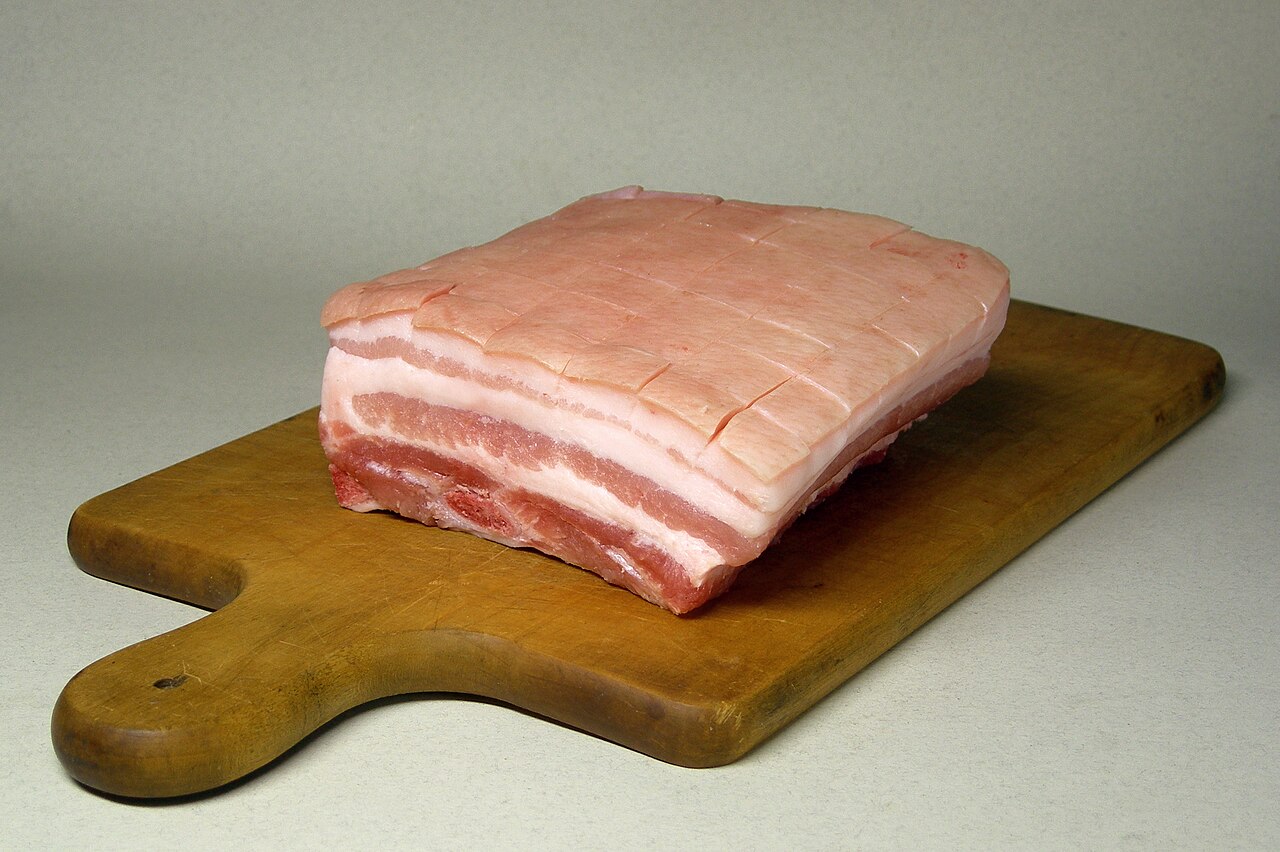
Pork belly is sold both ways, and the recipe decides which you want. Judy at The Woks of Life calls for lean, skin-on belly in Shanghai-style braised pork belly, because the braised skin has a gelatinous texture and its collagen gives the sauce a shiny, sticky quality, though she says the dish still works without it. Namiko Hirasawa Chen at Just One Cookbook notes that Japanese cooking uses belly without the rind, except in some Chinese-influenced or Okinawan dishes; if yours comes skin-on, she says to ask the butcher to remove it or trim it yourself with a sharp knife.
To trim it yourself, lay the belly skin side down, start the knife between the skin and the fat at one corner, and work along with the edge angled slightly toward the skin while you hold the freed flap taut. It is the same move as taking the silverskin off a pork tenderloin, on a larger scale.
Look at the layers before you buy. Judy looks for thicker strips of meat and thinner streaks of fat, and warns that a fatty belly can be up to 70% fat; a piece that is mostly fat can be trimmed and the fat saved to render.
Slabs and rolls for roasting and chashu
For a roast, leave the belly as one slab and cook it before you slice. For chashu, Just One Cookbook describes rolling a slab into a log and tying it with butcher’s twine as the classic ramen-shop method; smaller blocks need no rolling or tying.
The slicing comes after cooking. Chen chills the cooked pork overnight, because it firms up and slices cleanly, then slices it thinly, thick enough to pick up with chopsticks; her recipe card serves it in ¼-inch (6 mm) pieces. She finds a sharp bread knife makes the job easier; our guide to Japanese bread knives covers the long serrated blades that suit it.
Thin slices for grilling, hot pot or stir-fry
- Take off the skin. Unless your recipe keeps it, trim the skin off first, as above.
- Firm it in the freezer. RecipeTips partially freezes raw meat for 30 minutes to an hour before cutting thin slices, because it firms the meat and makes it easier to slice. Just One Cookbook includes pork belly among the cuts it slices this way, and says the meat is ready when a very sharp knife goes through smoothly. Its shabu-shabu recipe takes thinly sliced beef or pork, so these slices suit a hot pot too.
- Square the slab. Trim any ragged edge so the belly sits flat and steady on the board.
- Slice across the layers. Cut so that each slice shows stripes of fat and lean, rather than a slice of all fat. Chen cuts 1/8-inch (3 mm) slices in her thin-slicing tutorial; go thicker if your recipe asks.
- Use the whole blade. Start each slice near the heel and draw the knife back toward you in one long stroke, letting the edge do the work, rather than sawing back and forth or pressing straight down.
- Re-chill if it softens. Just One Cookbook’s advice is to put meat that has gone too soft back in the freezer until it is firmer.
If the belly was frozen solid, RecipeTips says to slice it before it is completely thawed. Thaw it in the refrigerator, never on the counter, as FDA advises.
Cubes for braising
The Woks of Life cuts its braising pork into pieces 3/4 inch thick, square or rectangular, and says the cooking time stays the same as long as the pieces are about that thick. Cut the slab into strips of that width first, then cut across the strips. RecipeTips notes that partial freezing helps with cubing as well as slicing. If you are cutting through skin, place it skin side down so the knife meets the meat first, and press steadily through the skin at the end rather than rocking or twisting a thin blade.
Which knife
Pork belly has no bone, so any sharp blade with some length works. A gyuto handles cubes and trimming, and a long, narrow sujihiki gives the full-length stroke that thin slices need. Keep the board for raw meat only; our cutting board for raw meat guide explains why.
Cook and clean up
FDA lists 145°F with a 3-minute rest as the safe minimum for pork chops, roasts and steaks, and says to marinate in the refrigerator. Wash your hands with warm water and soap for at least 20 seconds after handling raw pork, and wash the board and knife with hot soapy water. For other cuts of meat and vegetables, see all our how-to-cut guides.
Sources: Judy, The Woks of Life, Shanghai-Style Braised Pork Belly (skin-on belly, fat and lean, 3/4-inch pieces); Namiko Hirasawa Chen, Just One Cookbook, Chashu (rind, rolling and tying, chilling, slice thickness, bread knife); Just One Cookbook, How to Slice Meat Thinly (pork belly, freezing until firm, 1/8-inch slices); Just One Cookbook, Shabu Shabu (thinly sliced beef or pork); RecipeTips, Partially Freeze Meat for Easier Slicing (30 minutes to an hour, cubing, slicing from frozen); FDA, Safe Food Handling (145°F plus a 3-minute rest, thawing, marinating, handwashing, cleanup).