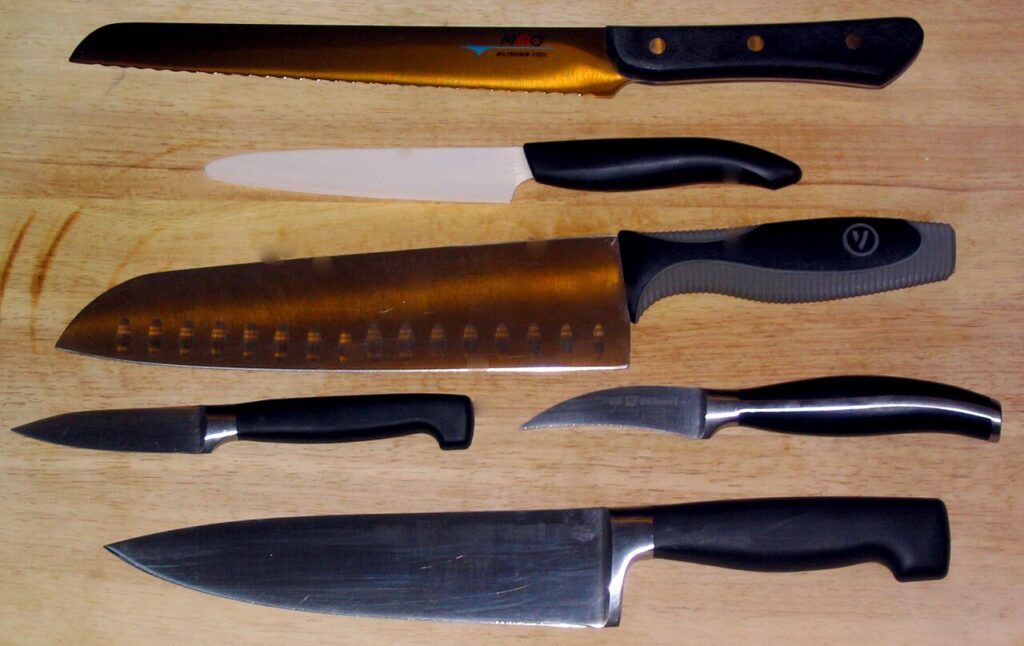
Can kitchen knives go in the dishwasher? Sometimes—but check the care instructions for the exact knife first. If its maker clearly marks that model dishwasher-safe, follow those directions. If the instructions are missing, unclear, or say hand wash, clean it by hand. Hand washing is the safer default because it avoids repeated contact with other utensils, strong detergent, and a hot drying cycle.
Why the answer varies by knife
Dishwasher guidance is not identical across makers or models. Victorinox says its synthetic-handled knives may be dishwasher-safe, yet recommends hand washing to protect blade and handle; its care guidance also recommends hand washing large knives. Henckels describes most of its knives as dishwasher-safe but still recommends washing them by hand and names Pakka and Compass Damascus knives as exceptions. ZWILLING likewise recommends hand washing to limit wear from cleaning agents. Those are maker-specific policies, not a blanket specification for every knife with a plastic handle or a stainless blade.
In a dishwasher, a blade can knock against cutlery or the rack as water circulates; repeated contact can damage an edge. Heat and detergent may also age some handles or finishes. The risk depends on the knife’s construction and its maker’s instructions, so do not infer dishwasher safety from appearance alone.
Use this quick decision
| What the exact instructions say | What to do | Why |
|---|---|---|
| This model is dishwasher-safe | Follow the maker’s placement and cycle guidance. | The maker has assessed that model’s materials and construction. |
| Hand wash only, or a wooden handle | Wash by hand and dry promptly. | Heat, water exposure, detergent, and movement can shorten the life of some handles and edges. |
| No clear care label or model page | Choose hand washing until you can verify the maker’s guidance. | A similar-looking knife may have different materials or construction. |
A quick, controlled hand wash
- Wash soon after use. Hold the knife so the blade stays visible and the edge points away from your hand. Use warm water, a little dish soap, and a soft cloth or sponge; keep fingers off the cutting edge.
- Clean separately. Do not leave the knife loose in a sink or submerged under soapy water where it can be hidden among dishes. Rinse it without letting it strike other metal tools.
- Dry it right away. Wipe from the spine toward the edge with a clean towel, keeping the sharp edge directed away from your fingers. Dry the handle as well.
- Put it away protected. Use a block, sheath, magnetic rack, or drawer insert that prevents the edge from hitting other utensils.
This brief wash-and-dry routine fits the after-use reset in our kitchen-knife maintenance schedule. For fuller storage options, see how to store Japanese knives.
Already washed it in the dishwasher?
Dry the knife, then inspect the handle and blade in good light. One dishwasher cycle does not prove the knife has been permanently damaged. If you see a stain, use the guidance in what to do about rust spots; if the handle is loose, cracked, or separating, stop using the knife until the maker or a qualified repairer advises you. If it simply feels less keen, follow the separate kitchen-knife sharpening guide rather than trying to test the edge with a finger. From here on, use the care method listed for your exact model.