To cut a globe artichoke, cut the stem off so it sits flat, slice about an inch off the top, and snap off the small leaves around the base. Leave it whole for steaming, or keep pulling off the tough outer leaves until you reach the pale inner ones, halve it lengthwise, scrape out the fuzzy choke with a spoon and cut it into quarters. Put the cut pieces into lemon water as you go to slow browning. Baby artichokes are trimmed the same way but usually have no choke to remove.
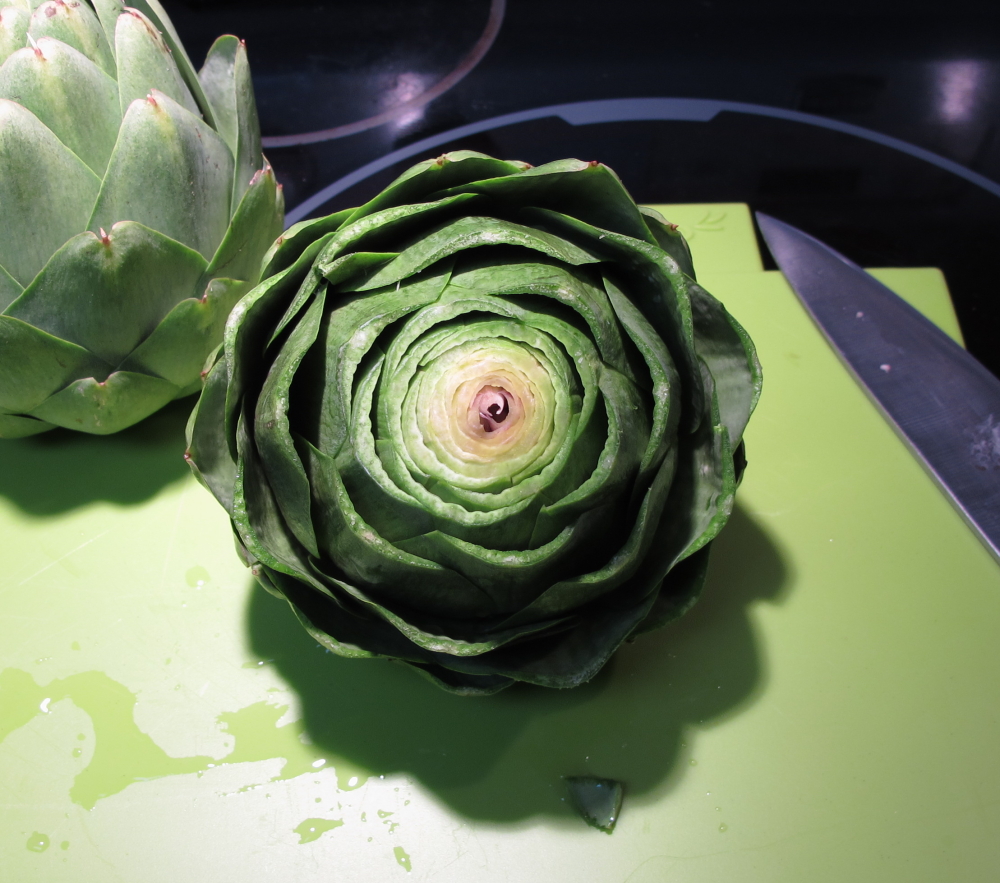
The parts you eat are the tender base of each leaf and the heart at the bottom; in a large artichoke, the fuzzy choke that sits on the heart is scraped out. How much you trim depends on whether you are cooking the artichoke whole or cutting it into pieces.
Set up first
- Make lemon water. Squeeze a lemon into a bowl of cold water before you start. Williams Sonoma drops trimmed and cut artichokes into lemon water to prevent discoloration. America’s Test Kitchen notes that many recipes instead rub every cut surface with a halved lemon.
- Rinse. Rinse the artichoke under cold running water, as Ocean Mist Farms does for baby artichokes, and shake it dry.
- Choose the knife. America’s Test Kitchen cuts the stem with a serrated knife and says it works better than a chef’s knife; Williams Sonoma uses a serrated knife to slice off the top. The tightly packed leaves and fibrous stem cut more easily with saw-like teeth than with a smooth edge.
Whole artichokes for steaming
- Cut the stem. Lay the artichoke on its side and cut the stem off flush with the base so it sits flat in the pot. America’s Test Kitchen does this because the stem is often fibrous. Some recipes keep the stem instead: trim a thin slice from the end and peel the rest.
- Cut off the top. With the artichoke still on its side, cut about an inch off the top. America’s Test Kitchen trims the top inch; Williams Sonoma takes 1 to 2 inches to remove the thorns. Hold it firmly and saw gently rather than pushing down hard.
- Snap off the small leaves. Pull off the tiny leaves around the base. America’s Test Kitchen notes that they hold little meat and get in the way when you eat.
- Trimming the leaf tips is optional. America’s Test Kitchen leaves the pointed tips on, since they soften as the artichoke cooks.
Halves and quarters
When a recipe calls for halves or quarters, the artichoke is trimmed further and the choke comes out. This follows the Williams Sonoma method.
- Pull off the outer leaves. Starting at the base, pull off the tough, dark outer leaves until you reach the tender, yellow inner leaves.
- Trim the stem and top. Cut the stem flush and slice off the top 1 to 2 inches of the remaining leaves.
- Halve lengthwise. Stand the artichoke on its flat base and cut down through the center.
- Remove the choke. With a teaspoon, scrape out the fuzzy choke from each half and drop the halves into the lemon water.
- Quarter if needed. Cut each half lengthwise again and put the quarters in the lemon water.
Use the spoon, not the knife tip, for the choke. Prying with the point of a thin blade puts a sideways load on the edge, which can chip a Japanese knife; see why Japanese knives chip.
Baby artichokes
Ocean Mist Farms, an artichoke grower, says baby artichokes come without the fuzzy choke and with fewer tough outer leaves than large ones, so they can be eaten whole. Its method is to wash them under cold water, cut 1 inch off the tops, peel or remove the dark green stem, and pull off outer leaves until you reach the pale, yellow-green ones. Halve or quarter them if you want them to cook faster, and keep them in lemon or vinegar water until you cook them. If a larger one shows fuzz when halved, scrape it out.
About the browning
Lemon water keeps the cut surfaces from darkening while you work. It does not keep the color through cooking; America’s Test Kitchen says artichokes turn olive green as they cook whether they were exposed to lemon or not. The cut leaves can also darken a carbon steel blade. Our guide to carbon steel kitchen knives lists artichokes among the foods that encourage a black patina, so wipe the blade between cuts.
Which knife
Use a serrated knife for the stem and top, then a petty or paring knife for peeling the stem and tidying the base; see our guide to paring and utility knives. A gyuto or santoku is fine for halving the trimmed artichoke on its flat base. For other vegetables, browse all our how-to-cut guides.
Sources: America’s Test Kitchen, How to Prep an Artichoke (serrated knife, stem flush or trimmed and peeled, top inch off, small leaves snapped off, tips left on, lemon on cut surfaces, olive green when cooked either way); Williams Sonoma, Trimming Artichokes (lemon water, outer leaves off to the yellow ones, stem flush, top 1 to 2 inches off, halve, teaspoon for the choke, quarter); Ocean Mist Farms, How to Cook Baby Artichokes (no fuzzy choke, wash, 1 inch off the tops, stem peeled or removed, halve or quarter, lemon or vinegar water).