To cut an orange, wash it and trim a thin slice from the top and bottom so it stands flat. For slices, lay it on its side and cut crosswise rounds. For wedges, halve it from end to end and cut each half into wedges. For segments without any membrane, cut the peel and white pith away in strips that follow the curve of the fruit, then cut each segment free from the membranes on either side of it.
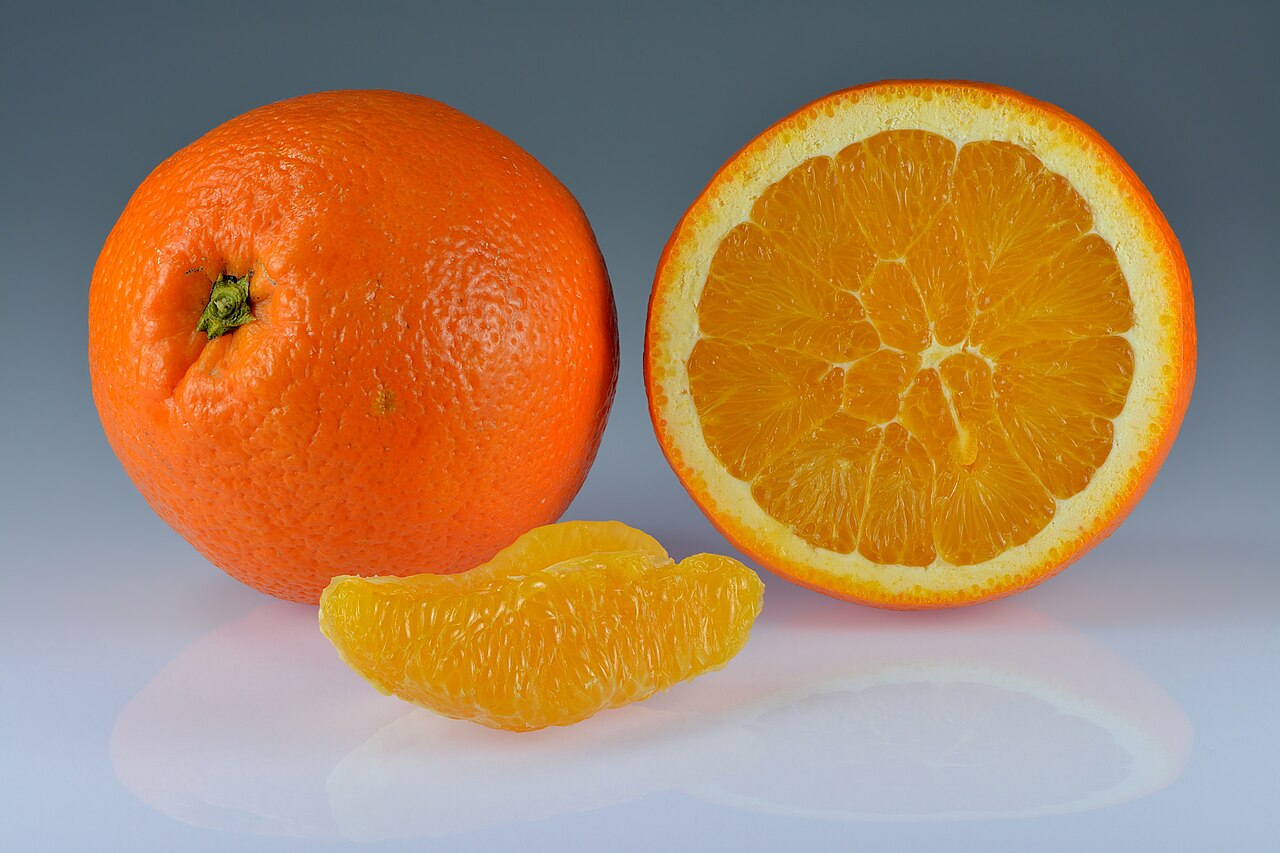
Membrane-free segments have a kitchen name: to supreme a citrus fruit is to remove its skin, pith, membranes and seeds and separate its segments, and a supreme is a segment prepared that way. University of California sources explain why cooks bother: the Master Food Preservers describe the white membrane as tough, and ANR Publication 8199 calls the white pith (albedo) bitter.
Wash first
University of California Agriculture and Natural Resources advises washing oranges before peeling or cutting them: wet each orange, rub its surface, rinse it under running water and dry it with a paper towel. Mississippi State Extension adds that soap should never be used to clean fruit. Washing matters even when you will not eat the peel: the same publication notes that bacteria on the rind can be transferred to the flesh during cutting, peeling or juicing.
Slices and wedges
- Trim the ends. Cut a thin slice off the top and the bottom.
- Slices (rounds). Lay the orange on its side and cut crosswise at an even width. Remove any seeds.
- Half-moons. Cut a stack of rounds in half for a half-moon shape.
- Wedges. Stand the orange on a trimmed end, cut it in half from top to bottom, lay each half flat, and cut it lengthwise into wedges.
Segments (supremes) step by step
This method is from the University of California Master Food Preservers of Amador and Calaveras counties:
- Cut off both ends of the fruit, so it looks like a sphere with flat ends.
- Stand it on one end and, with a sharp paring knife, slice off the peel and pith in large strips. Do not cut straight down; follow the contour of the fruit so you waste as little as possible. After each strip you should see the bright orange fruit beneath.
- Rotate and repeat until all the peel is gone and only the juicy sphere is left. Trim off any white pith that remains, since ANR describes it as bitter.
- Hold the fruit over a bowl to catch the juice and cut out each segment from between the strips of membrane surrounding it. Lift out the segment and remove any seeds.
- Squeeze the leftover membrane over the bowl once every segment is out, to collect the remaining juice.
Keep your fingers clear
Segmenting happens in the hand, so use a short, sharp blade and keep the holding hand out of the blade path, the same rule our pineapple guide uses; if the fruit shifts, set it down and reset it before cutting again. For slices and wedges, Mississippi State Extension’s knife basics apply: give the round fruit a flat surface and tuck your fingertips toward your palm.
Storing oranges
Mississippi State Extension says uncut oranges can stay on the counter for about 7 days and keep at least 3 weeks whole in the refrigerator. University of California advises covering and refrigerating cut or segmented oranges if they are not eaten within 2 hours of preparation; refrigerated, they last about 1 to 2 days.
The knife for this job
Segmenting is close work in the hand, which is the job of a paring or petty knife; our guide to the petty knife lists removing citrus peel, pith and individual segments among its tasks, and notes that a petty offers room to slice rather than saw through citrus. For a quick comparison of the short knives, see paring vs utility knife. Slices and wedges are board work for a santoku or gyuto. In our wa handle size guide, a 105–155mm petty takes the Compact handle; a petty under about 105mm is fitted individually.
Sources: University of California Master Food Preserver Program of Amador/Calaveras Counties, Preserving Citrus (supreming steps, tough membrane); University of California ANR Publication 8199, Oranges: Safe Methods to Store, Preserve, and Enjoy (washing, bitter albedo, cut oranges); Mississippi State University Extension, HappyHealthy Oranges fact sheet (no soap, storage); Wikipedia, Supreme (cooking) (term); Mississippi State University Extension, Kitchen Knife Basics (flat surface, curled fingertips).