Choose a fish spatula when you need a slim, beveled head to slide under a fillet or seafood cake; choose a broad turner for eggs, grilled cheese, and other compact foods. Before using either tool, check that its head material suits your pan. A stainless-steel fish turner works differently from a nylon or silicone turner made for coated cookware.
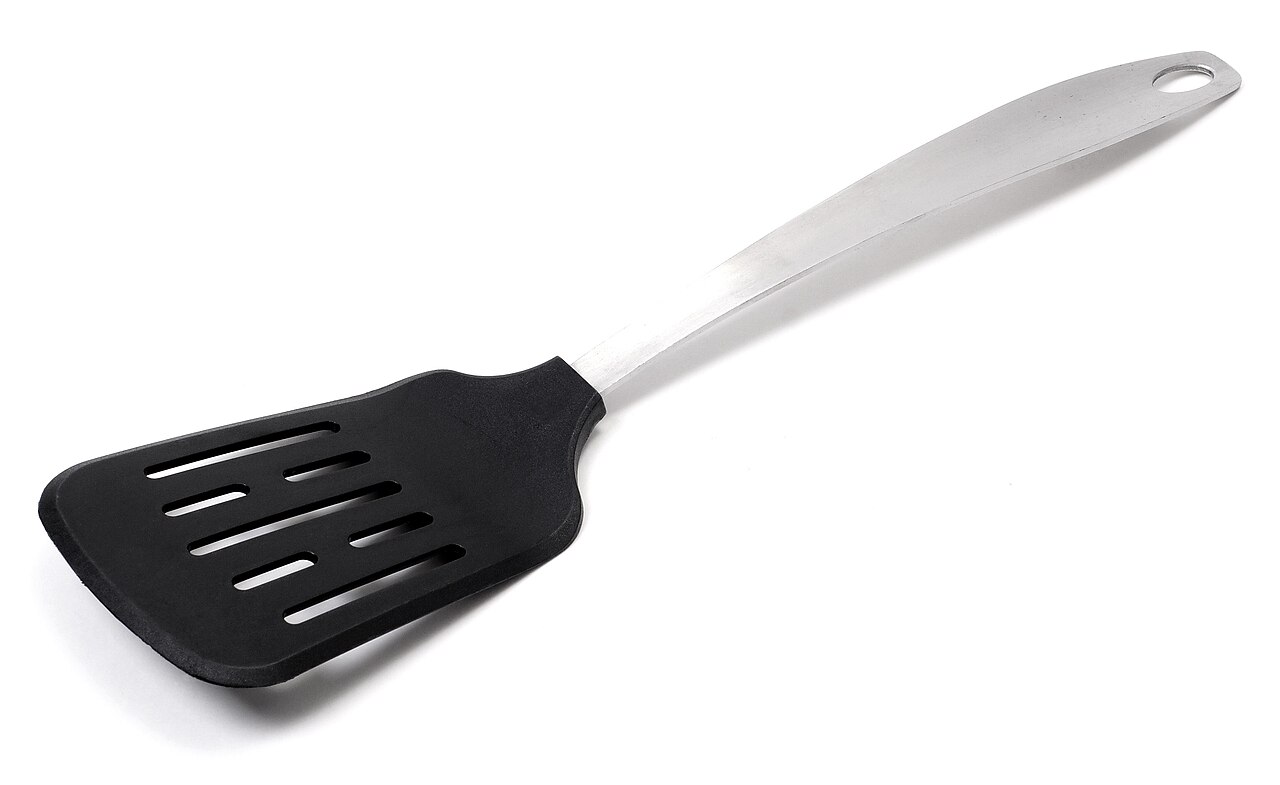
Choose by food and pan
| Your usual task | Head to compare | Check before buying |
|---|---|---|
| Lift or turn a fish fillet, whole fish, or seafood cake | Slim fish spatula, often beveled and slotted | Head width against the food and pan; whether the material is suitable for your cookware |
| Flip eggs, grilled cheese, or similarly compact food | Broad square or flexible turner | A wide head that fits the food; material and heat limits in the maker’s instructions |
| Cook on a nonstick or coated pan | A nylon or silicone tool explicitly marked safe for that pan | The exact pan and utensil instructions; avoid assuming any metal head is coating-safe |
Why the fish spatula head is different
A fish spatula is typically narrow, thin, and angled at the front edge. On its Fish Turner listing, OXO describes a beveled edge that slides beneath food and slots that let grease drain. The same model is listed for whole fish, fillets, and seafood cakes, with an oversized stainless-steel head. Those features make it a useful shape when the food needs support across a longer area but the pan leaves limited room to get underneath.
To use one, bring the beveled edge nearly flat to the pan and ease it under the portion from an open side. Move the head farther underneath before lifting so it supports more of the food. Turn with a controlled wrist motion, then lower the piece into place. If it resists, pause and work the edge in from another side instead of levering sharply.
When a broad turner is easier
A broad, squarer head gives a compact item more support during a flip. OXO describes its Nylon Square Turner for eggs and grilled cheese and says that this specific nylon model will not scratch nonstick cookware. It is a useful example of a general-purpose turner; the product name alone does not establish the shape, flexibility, or pan safety of every other turner.
Flexible heads can also follow the curve of a pan. OXO explains that its silicone-coated nylon omelet turner conforms to the pan surface. For any coated pan, follow the cookware maker’s utensil guidance and the exact turner’s labeling. A stainless fish spatula may be the right shape for a fillet but still be unsuitable for a particular coating.
Check fit before adding another tool
Compare the tool head with the largest portion you usually move and the usable width of your pan. A narrow fish turner is handy for a fillet but may feel small under a large pancake; a broad head can be awkward in a tight skillet. If you already have a turner that fits your food and pan, there may be no reason to buy another. Choose a fish spatula when its slim edge and length solve a recurring lifting task. If your question is about cutting along fish skin and bones before cooking, see the boning-knife vs fillet-knife guide.
Sources: OXO’s Fish Turner and Nylon Square Turner listings; OXO’s explanation of silicone over nylon in an omelet turner.