Choose tongs by the contact and reach your task needs. For a non-stick pan, look for tips the maker explicitly identifies as suitable for that cookware; for a long pan reach, compare handle length and the tool’s heat rating. For plating cool garnishes or placing a small item, tongs may be too broad; use a spoon or cooking chopsticks for better control.
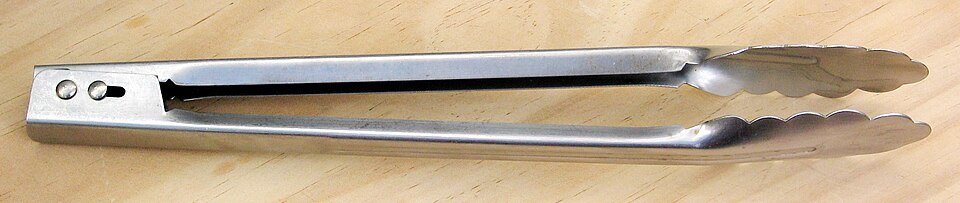
Choose tongs by task
| Task | Selection check | Verified example |
|---|---|---|
| Turn food in non-stick cookware | Look for maker-approved tip material and a stated heat limit | OXO nylon heads are listed as non-stick-safe and heat-resistant to 400°F |
| Reach into a deeper pan | Compare full length with your reach and control | OXO’s verified example is a 9-inch nylon-head model |
| Store in a crowded drawer | Check locking or compact storage feature | The OXO 9-inch example locks closed |
| Place a small, delicate item | Use a narrower tool if tongs feel broad | Saibashi may give more precise placement |
OXO’s 9-inch nylon-head tongs are listed as suitable for non-stick cookware, heat-resistant to 400°F and lockable. Check the exact product page for any other tong you consider. A handle length is a starting point, not a guarantee that the tool will feel controlled in your hand.
Check grip and storage
Inspect the jaw opening and tip shape against the food you handle. Check whether the maker says the head securely holds food and whether the lock is easy to use. A lock helps storage; it does not establish stronger grip.
For turning or lifting larger pieces, tongs give a direct grip. For noodles, a small leaf or careful placement, they may feel too broad. The saibashi guide explains when long cooking chopsticks add precision; Kikkoman also distinguishes the Japanese cooking-chopstick forms.
Before the first use
Test the open-close action over a cool plate. Confirm the tips meet as intended and the lock works before cooking. Follow the maker’s cleaning directions; nylon, silicone, wood and metal components can have different care limits. Before ordering, confirm tip material, cookware compatibility, length, heat rating, jaw shape, lock design and cleaning instructions.
For more practical tool decisions by task, visit the kitchen tools guide.