AUS-10 is a stainless blade steel from Aichi Steel. It is a credible material for a kitchen knife, but the name is not a quality score for the finished knife. To choose well, read it alongside the blade’s heat treatment, thickness, edge geometry, dimensions and handle. Two AUS-10 knives can suit quite different cooks. For a model-level comparison, see a comparison of VG-10, AUS-10, and X50CrMoV15.
The practical attraction is a stainless kitchen edge without the everyday reactivity associated with plain carbon steel. That still leaves the important buying question: is this particular knife shaped and finished for the work you want it to do?
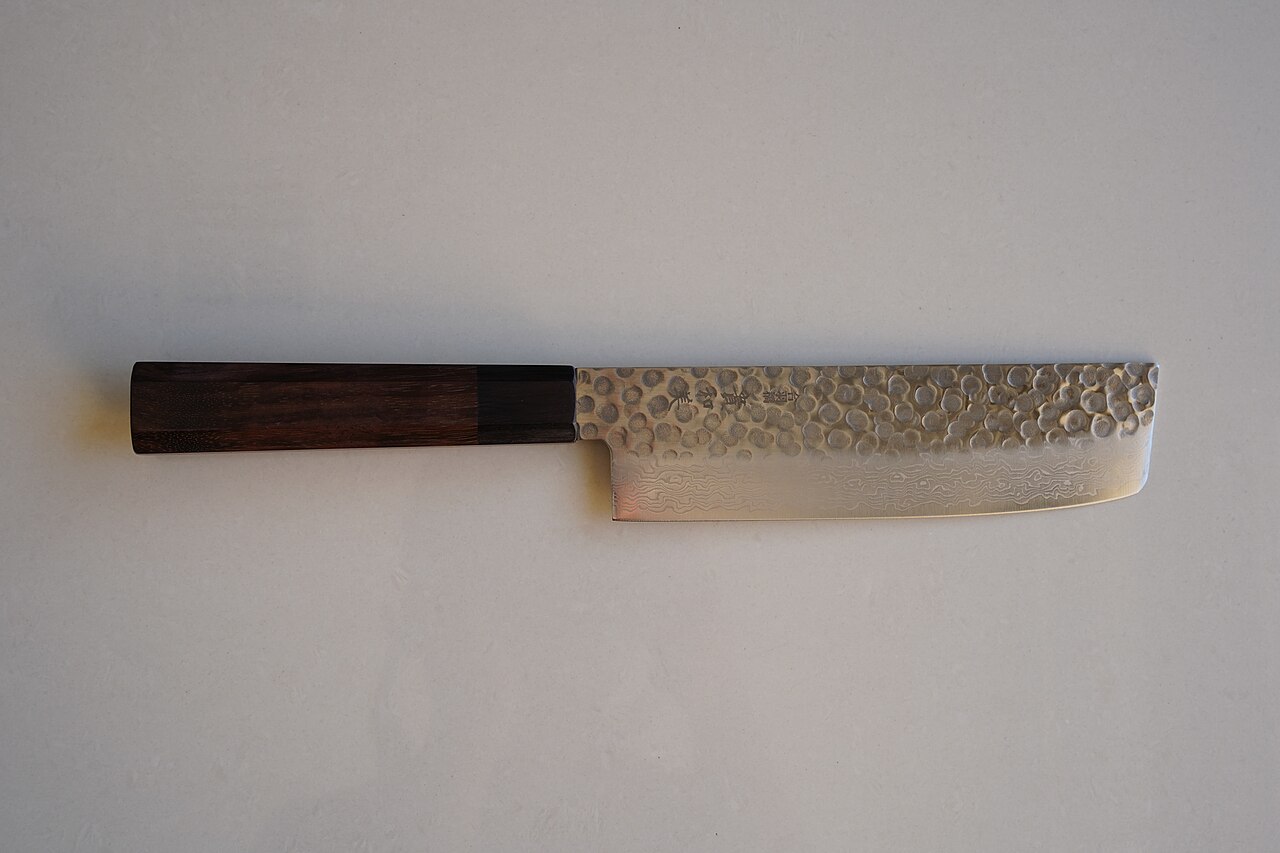
Stainless and high carbon can describe the same steel
“High-carbon stainless” is not a contradiction. Carbon contributes to the properties sought in a hardened blade, while alloy composition also provides corrosion resistance. Aichi lists AUS-10 among its stainless blade steels, together with AUS-6M and AUS-8, and describes carbon, molybdenum and vanadium additions intended to improve hardness and wear-related properties. Aichi Steel’s blade-steel classification.
This establishes what sort of material AUS-10 is. It does not establish how long every AUS-10 knife stays sharp, whether it can be abused or how a particular factory heat-treated it. Nor does “stainless” mean you should leave the knife dirty and wet.
If a listing mixes alloy names with claims such as “professional,” “premium” or “razor sharp,” separate those claims. The steel name is material information. The other words need evidence from the actual knife’s construction, finishing and support.
Hardness belongs to the knife, not just the alloy
Heat treatment turns blade steel into a working edge. A finished knife’s stated Rockwell hardness describes one result of that process; it does not tell you the whole process or its consistency.
As a concrete example, Hokiyama describes its Sakon Bokusui AUS10 models at 60 ± 2 HRC. That is the maker’s specification for those products, not a universal hardness for everything bearing an AUS-10 label. It should not be turned into a precise number for an unrelated knife. Hokiyama’s Bokusui specifications.
Higher hardness is also not an instruction to prefer one knife automatically. A knife’s edge angle, thickness behind the edge and intended task influence how it cuts and how it tolerates use. The steel basics guide explains the difference between hardness, wear resistance and toughness without treating them as the same property.
For a buyer, a clear model specification is useful. A shop claiming that the alloy alone guarantees exceptional edge life is leaving out too much of the knife.
AUS-10 and Damascus describe different parts
An AUS-10 Damascus knife often uses AUS-10 for the cutting core and patterned layers outside it. The visible pattern and the edge steel answer different questions.
Hokiyama’s Bokusui example makes this explicit: 33 outer layers on each side surround the AUS10 core, for a stated total of 67. That count describes the layered construction. It does not mean 67 separate cutting edges, and it is not a measure of how smoothly the knife will pass through a carrot.
The core can be sound in a plain-looking knife, and a dramatic pattern can surround a blade whose thickness does not suit your preference. Read “AUS-10 core,” “stainless cladding” and the finish as separate details. The san-mai and monosteel guide explains the structural distinction more fully.
Hokiyama also offers its AUS10 family in Japanese and Western styles with different finishes. That is a useful reminder that an alloy does not prescribe the handle or the overall form. Hokiyama’s range overview.
AUS-10 versus AUS-8 or VG-10 is a knife comparison
The numbers in AUS-8 and AUS-10 identify grades; they are not scores out of ten. A change in alloy can matter, but it does not make every AUS-10 knife a better purchase than every AUS-8 knife.
The same problem appears in AUS-10 versus VG-10 comparisons. Without comparable knives, heat treatments and test conditions, a universal ranking for sharpness, toughness or ease of sharpening overstates what the names tell you. Manufacturer descriptions of their own products can help identify intended use, but they are not a controlled test of every knife in both grades.
Instead, compare the particular models. Is one shorter and easier to manage on your board? Is one thinner behind the edge? Does one have a handle and heel shape you can use comfortably for a full preparation session? Is there a reliable sharpening route? Those differences remain relevant even if you cover the steel labels with your thumb.
What ownership should look like
Use an AUS-10 kitchen knife within the limits of its design. A fine gyuto edge is for controlled cutting, not prying, frozen food or finding bones by force. The material’s stainless status does not protect a thin edge from sideways loading. Japanese Knife Imports’ care guidance makes that distinction for thin, hard kitchen knives generally. JKI’s care FAQ.
Hand wash after use, remove food residue and dry the blade and handle before storage. Do not treat a corrosion-resistant blade as permission to soak a wooden handle or leave the knife against other utensils in a sink.
AUS-10 does not require an exotic sharpening kit merely because it is stainless. Begin with a suitable stone and the knife’s intended bevel geometry. Routine maintenance and chip repair are different jobs; the whetstone grit guide helps choose the stage rather than buying every grit available.
Read two listings without being distracted by the label
Imagine two AUS-10 gyutos. One listing gives blade length, heel height, weight, construction, hardness and care instructions. The other gives a layer count and several performance adjectives. The first gives you a better basis for deciding, even before you know which knife is more expensive.
Now imagine both listings are equally clear, but one knife is compact with a familiar handle while the other has a longer blade and a different balance. The right choice depends on your board, grip and usual ingredients. Use the first Japanese knife guide to connect those dimensions to actual cooking.
AUS-10 is useful information to have. Let it establish the steel category, then choose the finished knife on the details that your hand and food will meet.