Use a fine mesh skimmer when you want to lift foam from the surface of a simmering pot while allowing most of the broth to drain back. Use a ladle when you need to move liquid as well. A ladle can also skim, so the mesh tool is most useful when repeated skimming is carrying away broth you want to keep.
The Japanese akutori ami is a small, fine-mesh tool for this surface work. It is different from a broad frying skimmer used to lift food from oil, and from a sieve through which you pour a whole batch of stock.
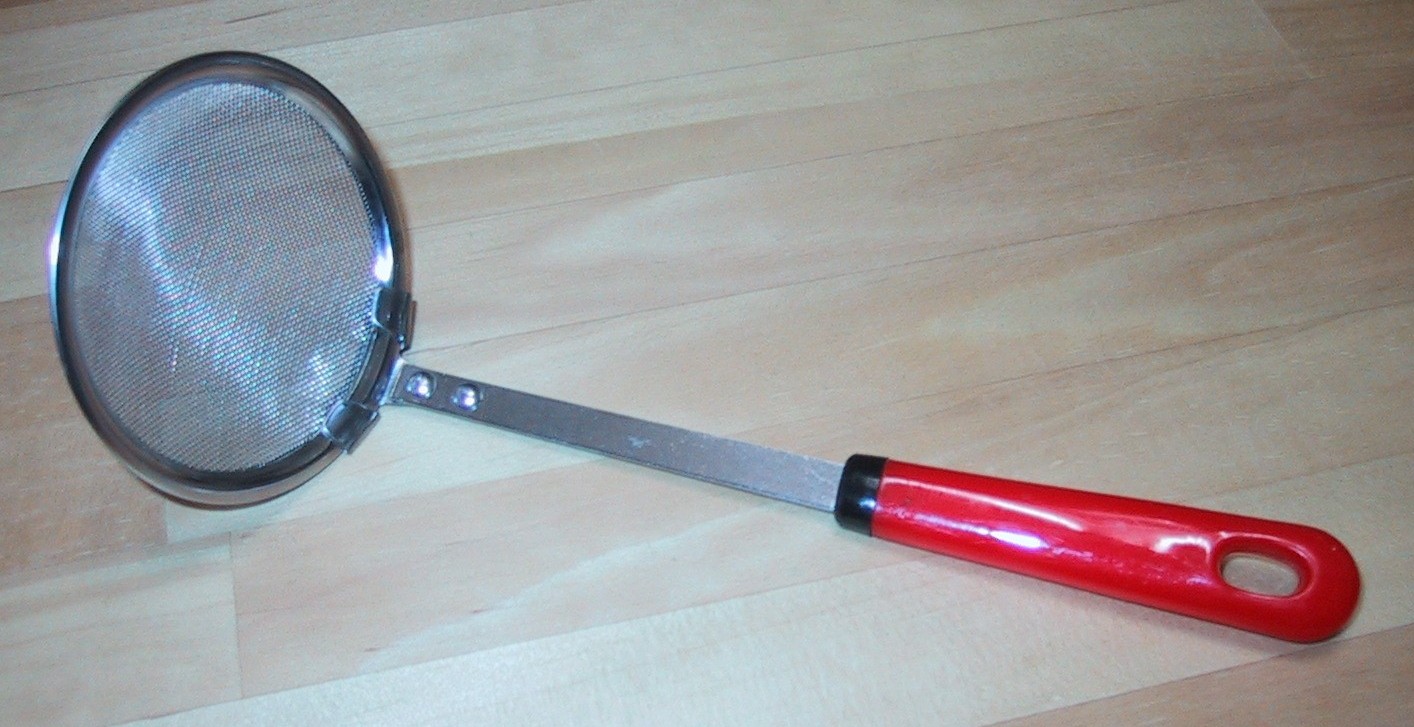
Decide what you are trying to remove
Start with the task, not the name on the utensil rack. Foam floating on broth needs a shallow pass across the surface. Whole dumplings or vegetables need a tool that supports their weight. Stock solids need a filter positioned over another vessel.
Kikkoman’s akutori explanation describes a small head and fine mesh that can move around ingredients. It notes that this loses less broth than a ladle. The useful consequence is practical: less liquid goes into the discard bowl while you remove the surface material.
A fine mesh does not make every soup better. Follow the recipe’s skimming instructions and remove the visible material it identifies. There is no need to turn this into a promise about extracting toxins, preserving nutrients or making a cloudy soup perfectly clear.
Use a skim-and-rinse rhythm
Set a bowl of water beside the cooking area before you begin. As foam collects, draw the skimmer through the surface layer, lift it and let the broth drain. Rinse the head in the water bowl to clear it before the next pass. This is the routine in Kikkoman’s tool guidance.
Aim for the patch you can see rather than plunging the head to the bottom and stirring the whole pot. Keep the food in place and move through the available gaps. A small head is useful here because the opening between ingredients may be much smaller than the pot itself.
A clean head for each pass helps you see what you are collecting. If the mesh is covered with the previous scoop, clear it before trying to collect more. Replace the rinse water when it no longer clears the tool effectively.
If you are using a ladle, approach with its rim near the surface and collect the foam with as little broth as practical. Empty and rinse it between passes too. You may find that a ladle is entirely adequate for an occasional small pan, while a mesh skimmer makes a repeated task easier.
Skim at the stage the recipe needs
A practical example is Kikkoman’s oyakodon lesson: foam is removed while the chicken cooks in the seasoned liquid, before the egg is added. The tool fits into a cooking sequence; it does not determine the cooking time or doneness.
Read that sequence before starting. If you wait until delicate finishing ingredients are in the pan, you may have less room to move the head without disturbing them. If the recipe does not ask for skimming, do not assume the dish needs an extra stage simply because you own the tool.
For a crowded pot, consider whether your head can reach the exposed liquid around the ingredients. A tool that looks efficient in an empty saucepan may be difficult to place once the pan is full. That is a better sizing test than choosing the largest diameter available.
Mesh, perforated plate and frying skimmers
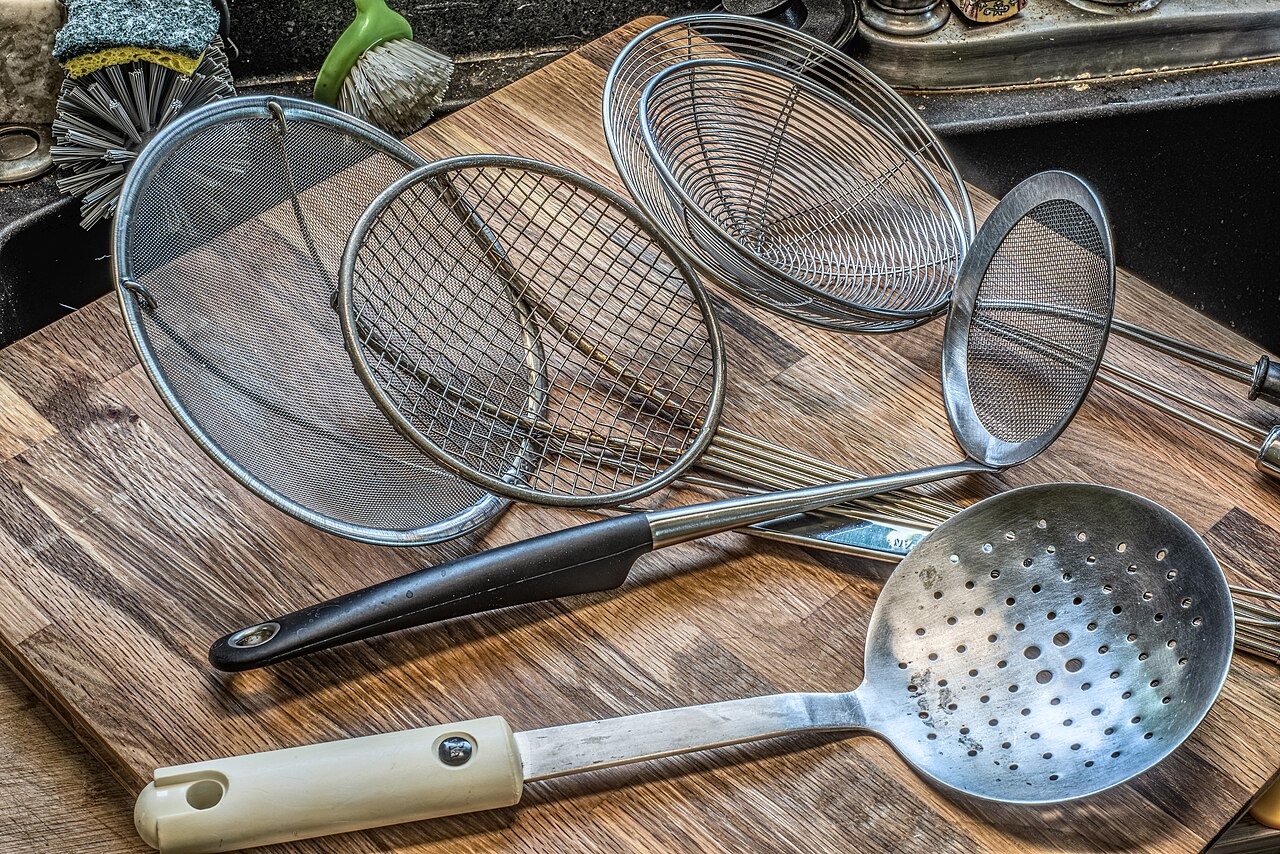
Fine woven mesh and a perforated metal plate are distinct constructions. Look closely at the actual head rather than assuming everything sold as a skimmer has the same openings.
KAI’s SELECT100 DH3109, for example, uses a perforated stainless plate and is sold for both foam and cooking scraps. KAI describes its shape as following a pot’s curve and rates it dishwasher-safe. The maker presents its plate construction as easier to wash and more robust than mesh; that is a maker’s comparison, not a hands-on ranking here.
A frying skimmer has another working environment. Kikkoman’s frying-colander glossary describes lifting fried food and collecting loose batter, with fine mesh for small crumbs and perforated designs as another option. Choose one expressly intended for frying when that is your job. A general soup-skimmer description does not establish that every handle and joint is suitable for hot oil.
Choose for reach, then check the cleaning routine
The handle should let you reach the part of the pot you need without an awkward grip. The head should fit between the food and the rim. Check the overall storage length as well: a long handle can be useful at the stove and inconvenient in a shallow drawer.
After cooking, remove trapped residue and wash according to the maker’s instructions. Check where the head meets its frame and handle, not only the open centre. Dishwasher suitability comes from the specific product; KAI’s approval for one stainless model does not cover every mesh tool with a wooden or plastic grip.
If particles pass through, compare their size with the openings and confirm you chose the right task. Pouring finished dashi through a stock strainer is a separate operation from collecting floating foam. A surface skimmer cannot replace that full filtration step simply by making more passes.
For a kitchen that makes soups and simmered dishes regularly, the benefit is a more controlled small action: collect the foam, return the broth, rinse and repeat. If your ladle already does that comfortably, keep using it. Our Japanese kitchen tools guide helps place specialist utensils alongside the basics.