Choose a yukihira saucepan around the amount you normally cook, then confirm that the exact model works on your hob. After those two decisions, compare pouring lips, measurement marks, handle size and lid availability. The name describes a family of saucepans; it does not give every pot the same capacity, construction or heat-source compatibility.
For a small soup or broth task, a manageable pan with useful pouring features can be a better fit than a larger pot bought for occasional entertaining. Begin with an ordinary meal, including the solid ingredients and room needed for stirring, rather than choosing from diameter alone.
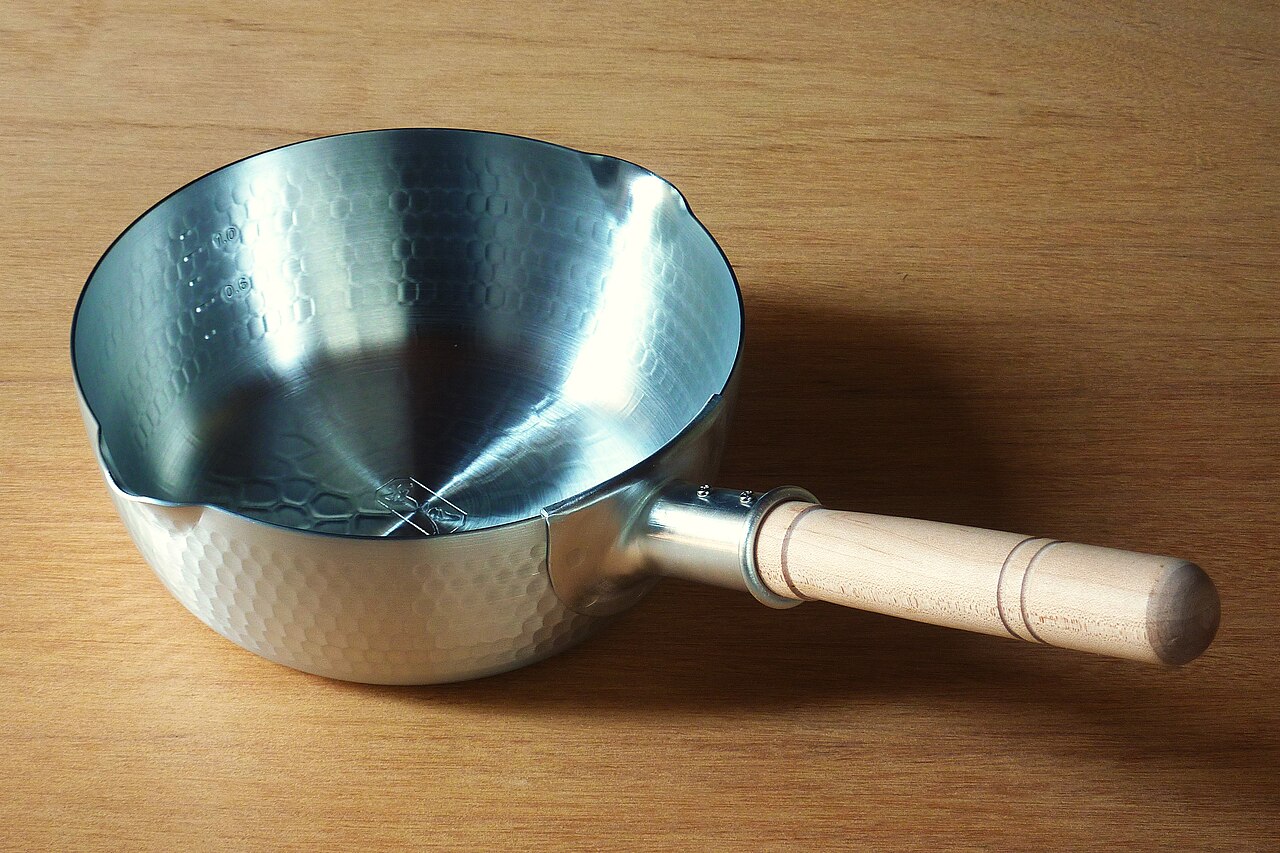
The task that makes this form useful
A yukihira is worth considering when you often heat modest quantities and pour the result into another vessel. Yoshikawa describes soup, stewed dishes and broth among the uses for its line; Miyazaki includes small preparation tasks such as blanching vegetables. Their products offer different constructions within the same broad saucepan category. See Yoshikawa’s stainless range and Miyazaki’s Objet range.
Think through the movement as well as the cooking. If you regularly lift a pot to divide broth between bowls, the handle and pouring lip matter every time. If you mainly leave a covered pot on the stove and serve with a ladle, lid fit and working capacity may deserve more attention.
There is no requirement to replace a saucepan that already does those jobs well. A yukihira earns its place when its form solves an inconvenience in the routine you have.
A 16 cm label does not tell you the whole size
These maker-listed examples show why diameter is an incomplete comparison:
| Named model | Listed diameter | Listed capacity |
|---|---|---|
| Yoshikawa YH6751 | 16 cm | 1.2 L |
| Yoshikawa YH6752 | 18 cm | 1.6 L |
| Miyazaki Objet | 16 cm | 1.5 L |
The two 16 cm pots have different stated volumes. Diameter describes one dimension; the rest of the shape determines how much space the pan contains. Use the particular product’s capacity specification instead of assuming a standard volume for all pans with that diameter.
Nor should the listed capacity become your default cooking fill. Liquid, solid ingredients, stirring and bubbling all need consideration. Follow any working-fill guidance for the actual pan and recipe; there is no useful universal percentage to apply to every dish.
For example, “I usually heat 800 ml of broth” is a helpful starting measurement. If the same pot will also hold vegetables, the liquid figure alone is incomplete. Compare the whole task, including the space you need to move a spoon without crowding the rim. The example is a way to assess size, not a prescribed serving volume.
Measurement marks and pouring lips should serve a routine
Yoshikawa’s 16 cm model lists marks at 400, 600, 800 and 1,000 ml; the 18 cm adds a 1,200 ml mark. The line also has pouring lips on both sides. These features are useful for a cook who repeatedly measures liquid into the pot and pours it out again.
Marks can save a separate measuring step when they correspond to the quantity you need. They are not a reason to discard a measuring jug, nor should the highest printed mark be read as permission to cook every food at that level. Their practical value is strongest when they match a repeated task.
Two lips give a choice of pouring direction. Consider the hand you use, the position of the receiving bowl and the available counter space. In a crowded kitchen, a feature that accommodates your normal movement can matter more than an extra nominal size option.
For a pot chiefly used with a ladle, neither the second lip nor the marks may be decisive. Rank features by how often you will use them.
Check induction at model level
Do not infer induction compatibility from a hammered appearance, the word “stainless” or the name yukihira. Yoshikawa’s 2024 catalog, dated December 21, 2023, labels its 14 cm YJ3367 gas-only and excludes that size from the range’s induction-compatible sizes. This is a specific catalog example, not a rule about all small saucepans.
Miyazaki lists gas, halogen, electric cooking heaters and IH for its Objet yukihira. It describes a three-layer body with aluminum between stainless-steel layers. That construction belongs to the named range; it should not be assumed from a retailer’s generic “Japanese saucepan” heading.
For induction, check the pan approval and your hob’s cookware requirements together. For gas, consider how the actual pot sits on the support and where its handle projects. A compatible material still has to form a workable setup on the stove you own.
Decide about the lid before buying the pot
A lid is not automatically included. Miyazaki explicitly says its Objet yukihira has no dedicated lid supplied, but that a separately sold Objet lid can be used. That is a concrete accessory route, rather than a promise that any lid carrying the same diameter label will fit.
If your usual cooking needs a lid, include the matching part in the comparison from the start. Check the complete cost and the storage space for both pieces. If you mostly warm broth uncovered, an optional lid can remain optional.
Look at the full handle-to-rim length too. Pot diameter does not show whether the saucepan fits beside another pan, inside the sink or on its intended shelf. Compare the complete dimensions rather than estimating from the product photograph.
First use and cleanup are part of the choice
Yoshikawa’s stainless yukihira instruction sheet calls for washing with a sponge and dish detergent, rinsing and drying before first use. It specifies hand washing and drying after use, excludes the dishwasher, and says not to soak the wooden handle. Those directions illustrate why the handle and body must be considered together.
The same sheet advises softening burned-on food with water rather than scraping it away with a knife or spatula. If dishwasher cleanup is a requirement for your kitchen, settle that compatibility before buying; stainless steel in the body does not establish permission for the complete saucepan.
Miyazaki separately explains its first-use vinegar advice: the aim is to remove possible manufacturing residue, and thorough washing with dish detergent is also acceptable. It is cleaning guidance, not a universal seasoning ritual for all yukihira pans.
The best shortlist is therefore small: pots that hold your usual batch comfortably, work on your stove, pour the way you use them and fit your cleaning routine. The broader kitchen tools guide helps assess the same relationship between useful work and maintenance for the rest of the kitchen.