Does a left-hander need a left-handed Japanese knife? For double-bevel knives—gyuto, santoku, bunka, nakiri and petty—no special version is normally needed, unless the maker ground the edge asymmetrically or fitted a D-shaped handle. Both can be handed. For single-bevel knives—yanagiba, deba and usuba—the answer is yes: a right-handed blade steers away from a left hand. Left-handed versions are made in smaller numbers, often to order, and are usually more expensive.
The useful checklist is short: bevel, grind, handle. Those three things can be handed. Everything else works in either hand.
Reading a single-bevel listing
A yanagiba, a long slicing knife commonly used for raw fish; a deba, a heavy fish-butchery knife; and an usuba, a specialist vegetable knife, are the familiar single-bevel cases. Most single bevels are made right-handed by default, so handedness must be confirmed before buying.
To identify the orientation, place the knife edge down with its tip pointing away and view it from above. A right-handed blade carries its ground bevel on the right face. Its flatter, hollowed back—the ura—is on the left face. A left-handed blade is the mirror image: bevel on the left face and ura on the right.
This is a recognition check, not a substitute for a clear listing. If the description does not explicitly say “left-handed,” the knife is almost certainly the more common right-handed version. Ask the seller to confirm which face carries the bevel and which carries the ura before paying.
For the underlying blade geometry, including why the orientation affects steering, see single bevel vs double bevel. The practical buying point here is simpler: a left-hander should choose the mirrored single-bevel blade rather than assume that a right-handed one will behave neutrally.
The less obvious case: an asymmetric double bevel
Most familiar all-purpose Japanese knife types are double bevel and work in either hand. The word “double,” however, does not guarantee that both sides were ground equally.
Some makers use an asymmetric double-bevel grind, described as 70/30 or with a similar bias toward a right hand. It is still a double bevel, but the unequal grind can influence how the blade moves through food. A left-hander may notice slight steering even though the knife was not presented as a traditional single bevel.
A left-handed buyer should look beyond the knife category and scan the listing for terms such as “asymmetric,” “right-hand bias,” “right-handed grind” or “70/30.” If the wording is unclear, ask whether the grind is symmetric and, if not, whether a mirrored version is available. The sensible choices are a symmetric grind, a mirrored asymmetric grind, or knowingly accepting a knife that may steer slightly.
This matters most when a listing casually calls a knife suitable for everyone while describing the grind elsewhere. “Double bevel” answers one question; it does not always answer the handedness question.
The handle: only the D-shape is handed
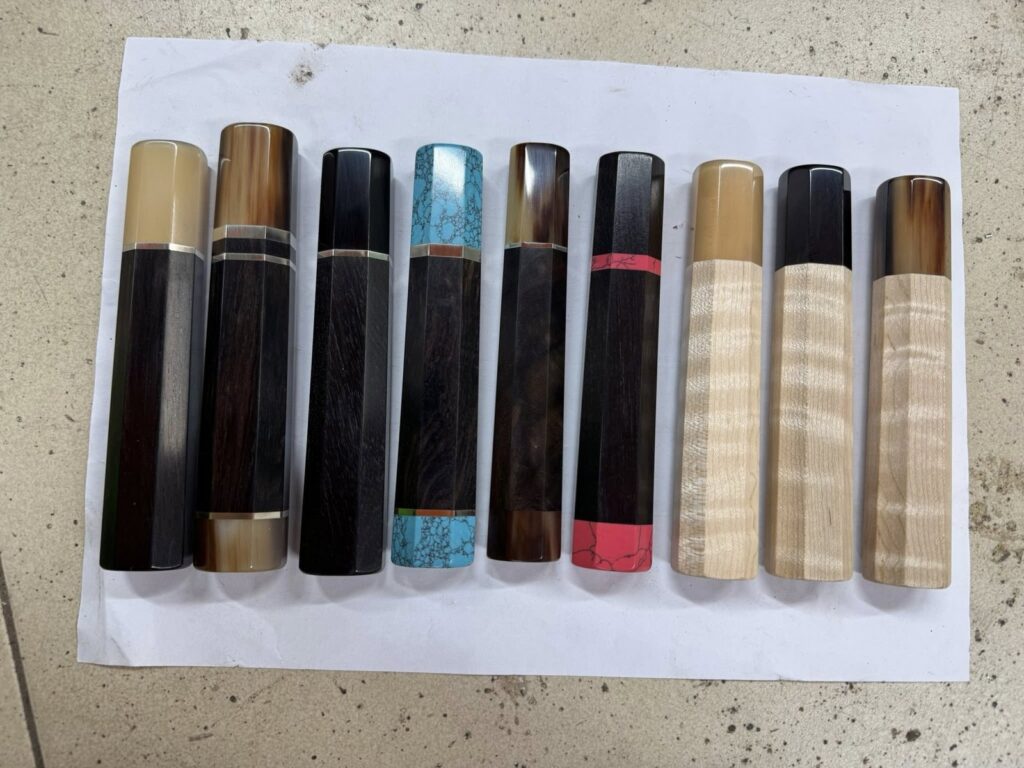
Among common wa-handle profiles, only the D-shape is handed. Its form leans one flat toward the palm and therefore favours one hand. Reversing that orientation produces the corresponding version for the other hand.
Octagonal, oval and round handles are symmetric, so they work in either hand. Their broader shape differences belong in the guide to octagonal vs oval wa handles; handedness alone does not require choosing between them.
At Horn & Grain, our left-handed D-shape configurator offers a Right-handed or Left-handed D-shape and asks for the primary user’s orientation before the profile is confirmed.
For a rehandle, check the existing blade and the proposed handle separately. A double-bevel blade may be neutral while its current D-shaped handle is not. Conversely, replacing a D-shape with a symmetric profile removes the handle-orientation issue but does not alter any handedness built into the blade or grind.
What changes at the sharpening stone
A left-handed single bevel is sharpened in the same manner as its right-handed counterpart, but the process is mirrored. Most written instructions, diagrams and videos show a right-handed blade, so a left-hander must mentally reverse which face is being worked at each stage.
That reversal is expected when the knife itself is left-handed. A left-hander sharpening and using a right-handed single bevel is not solving the mismatch at the stone; they are fighting the blade’s geometry. That is the practical reason to buy the mirrored knife in the first place.
On double-bevel knives, handedness does not change the sharpening process. A symmetric edge remains symmetric. If the edge has a deliberate asymmetric bias, the sharpener should know whether that bias is to be preserved, mirrored or intentionally made symmetric, rather than changing it by accident.
Why left-handed single bevels cost more
The premium is mainly a production question, not a claim that a left-handed cook needs a more elaborate knife. Most single-bevel production serves right-handed users, while mirrored blades are made in smaller numbers.
A Sakai maker’s left-handed page describes these knives as often made to order. Separate production, lower volume and less routine availability are why left-handed versions are usually more expensive. The premium belongs to the mirrored blade requirement; it should not be treated as a general surcharge on every knife a left-hander buys.
That distinction prevents needless expense. A symmetric double-bevel knife with a symmetric handle does not become unsuitable merely because no left-handed edition appears beside it.
Buying a knife as a gift for a left-hander
A thoughtful surprise needs one quiet check before purchase: is the recipient left-handed? Then identify whether the knife is single or double bevel. If it is single bevel, confirm that the listing explicitly identifies the left-handed version. If it has a D-shaped handle, confirm the left orientation as a separate detail.
When those answers are unavailable, a double-bevel knife with an octagonal or oval handle is the safer hand-neutral choice. The gift trap is not simply forgetting that someone is left-handed. It is choosing a right-handed single bevel that steers away from the hand that unwraps it, or selecting an otherwise neutral blade with a D-shape facing the wrong way.
For a knife that will be rehandled, the same three-part check applies: bevel, grind, handle. Handle fitting itself concerns the tang and the machi, the blade-to-tang transition, regardless of which hand uses the knife; the anatomy of a Japanese knife provides that wider context.
Remember the relief behind the checklist: only the bevel, an asymmetric grind and a D-shaped handle can require a handed choice. Once those are confirmed, everything else works in either hand.