Use a rod only if your knife maker recommends that tool and method. Japanese knives vary, and steel, ceramic and diamond rods do different work. If the edge remains dull, use the maker’s recommended sharpening method.
Choose by the exact tool and knife
| Tool or signal | What it does | Next step |
|---|---|---|
| A steel the knife maker approves | Shun describes its honing steel as a realignment tool and gives a 16° method for its own knives. | Use Shun’s method only with the Shun system; do not transfer its angle to another knife. |
| Ceramic or diamond rod | These are abrasive sharpening tools. Shun explicitly describes its ceramic rod as removing material from Shun edges. | Use only when the maker approves that tool for the knife. |
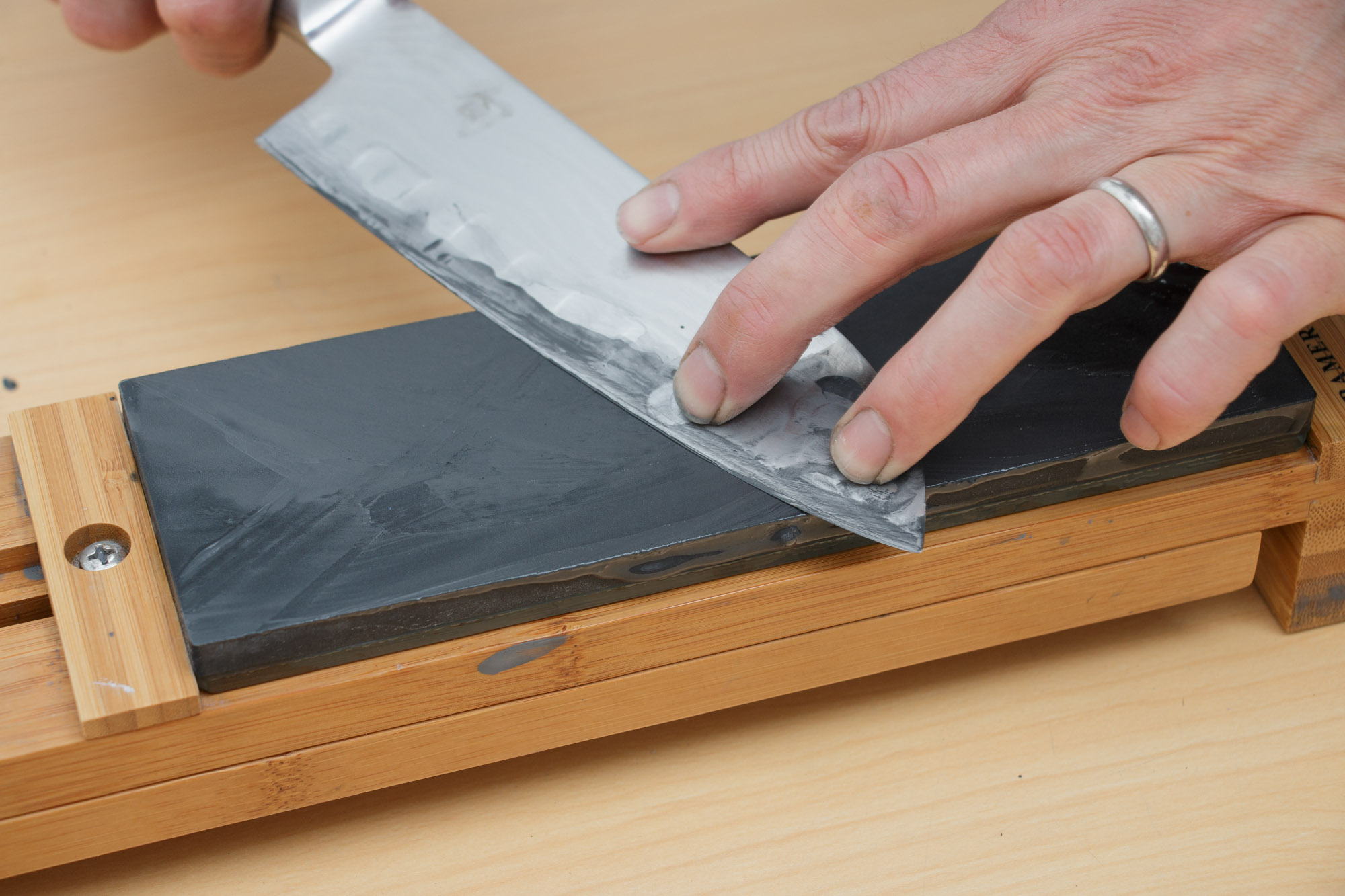
| The edge is dull or a rod does not restore cutting | A touch-up has not restored the edge to useful performance. | Sharpen on a compatible stone or choose a qualified service. A stone can follow and reset the bevel directly. |
| A chip, single-bevel edge or serration | This needs a method matched to the damage or edge geometry. | Ask a qualified sharpener or consult the knife maker’s care guidance. |
“Honing” and “sharpening” are not a perfect tool label
In everyday language, honing usually means maintaining a usable edge between sharpening sessions. Some makers use the word for a realignment step, while ceramic and diamond rods remove steel as they sharpen. Even steel contact can change the edge: one microscopy demonstration found metal removal and a small micro-bevel in the tested setup. That is a useful caution against assuming every steel rod only straightens an edge; it is not a result for every rod, knife or technique. For the broader comparison across all kitchen knives, see honing vs sharpening.
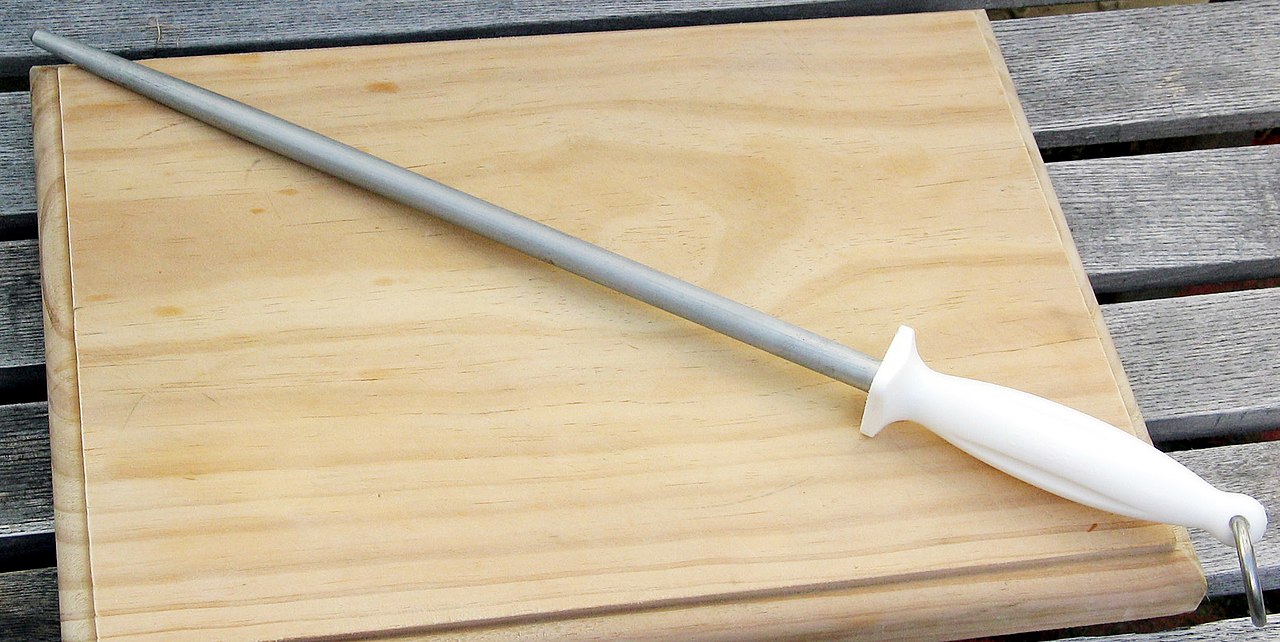
Shun distinguishes its Honing Steel from the Fuji Ceramic Rod: the steel is described for honing and the ceramic rod for sharpening. Its 16° guide applies to Shun’s own steel and knives; it is not a general Japanese-knife angle.
If you use an approved steel
Use a rod long enough for the blade. WÜSTHOF demonstrates a supported, point-down method: rest the steel tip on a dry, firm surface, then draw the knife down it with controlled strokes. This is one maker’s technique; use it only if it matches your tool’s directions. Avoid forceful strokes or changing the angle just to make the knife feel sharper.
A rod is a convenient touch-up when the exact knife and tool are compatible. A whetstone is the more direct choice when the edge needs sharpening, and the sharpening-angle guide explains how to read and follow an existing bevel. If the knife still cuts cleanly, there is no need to use a rod on a schedule.
Sources: Shun Cutlery FAQ; WÜSTHOF’s supported steel method; Science of Sharp’s microscopy demonstration (one tested setup; not a universal rod result).