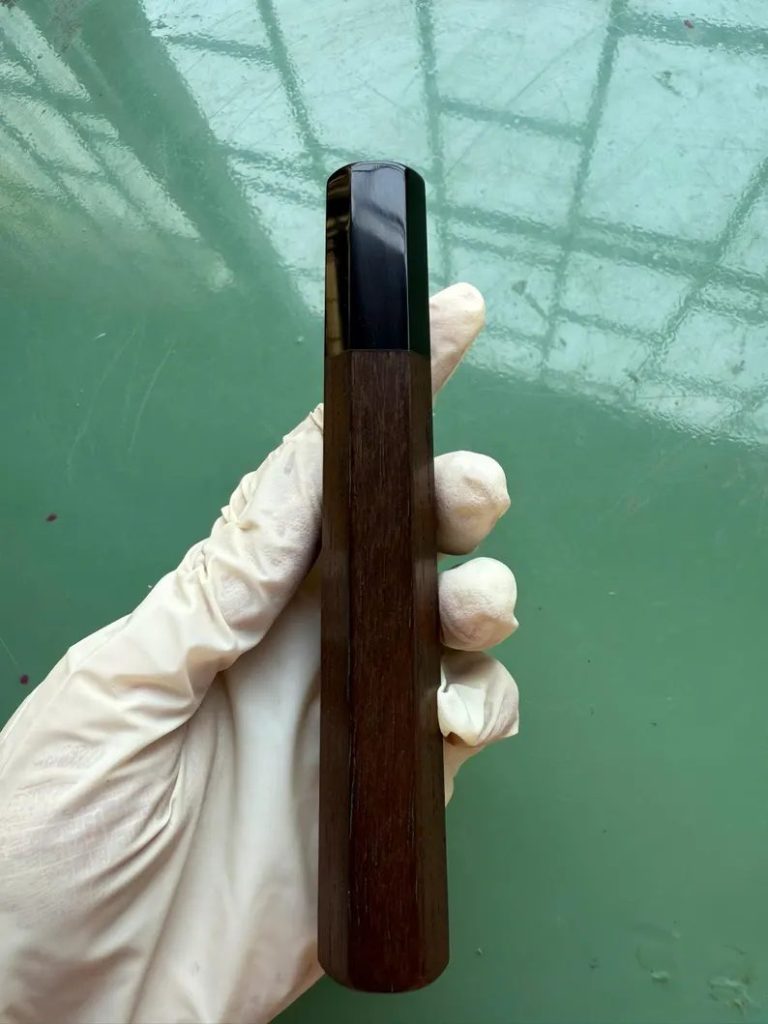
A saya is a fitted wooden sheath for a knife blade. Traditionally made from a soft, light wood such as hō, or magnolia, it follows one blade’s profile rather than a general size class. Friction holds it in place, usually with help from a small pin. Its job is simple: protect the edge from everything around it, and everything around it from the edge.
Does your knife need one? Ask whether it travels or shares space. A knife that lives alone on a rack mostly does not. Like anything in a kitchen tools guide, a saya earns its place by solving a real problem.
What a saya actually is
A saya is a close-fitting wooden cover made for a knife blade. It is not part of the handle, a display stand, or a general-purpose box. It surrounds the blade while leaving the handle accessible, creating a wooden barrier between the sharpened edge and the rest of the world.
Japanese sayas are traditionally associated with hō wood, often translated as magnolia. The practical appeal is easy to understand: a light, workable wood can be shaped closely without turning the cover into a heavy object. Other woods are also used, so “saya” describes the fitted wooden form rather than one mandatory material.
A saya is commonly made for one specific blade profile. Two knives that appear similar may differ enough that the same cover fits one and rattles on the other. That individual fit is the defining feature. A universal guard protects by accommodating a range of blades; a saya protects by closely following one.
There is also a quieter reason people like them. A slim piece of shaped wood feels natural beside a carefully made knife. That pleasure is real, but it is secondary. If the cover does not protect the edge reliably, its beauty cannot rescue it.
How a saya stays on
The main holding force is friction against the broad faces of the blade. The internal space follows the blade closely enough to resist sliding, but it leaves clearance around the sharpened edge. Many sayas also use a small removable pin passing through matching holes near the opening. The friction provides the fit; the pin adds security.
A good fit feels snug, not forced. The blade enters smoothly, settles into place, and stays there during ordinary handling. The pin should pass through its holes without needing to be pushed at an angle or driven in. When the saya is removed, it should release deliberately rather than suddenly.
Too loose and the cover can slide or fall away when the knife is lifted. A loose saya is, sooner or later, a dropped saya. It can also let the blade move inside, allowing the edge to knock or scrape where it should remain clear.
Too tight is not better. Forcing the blade in can stress or split the wood, and an overly close internal surface may rub the edge. Wood can also respond to moisture, so a fit that changes noticeably is worth treating as a warning rather than overcoming with more pressure.
The pin is a retainer, not a cure for poor fit. It can stop a properly fitted saya from slipping off, but it cannot keep a badly fitted cover from rattling against the blade.
When a saya earns its place
A saya is useful when a knife shares space. That may mean a drawer, a busy communal kitchen, a temporary move, or any other setting where utensils and hands might meet an uncovered edge. It is also useful when the knife travels, because movement creates repeated opportunities for contact even when everything was packed neatly at the start.
In those situations, the saya performs two equal duties. It shields a fine edge from knocks and abrasion, and it shields fingers, bags, surfaces, and nearby objects from the edge. It does not make careless handling safe, but it removes one exposed hazard.
A knife kept by itself on a secure rack has much less need for one. Nothing is loose around the blade, and the knife is not shifting in transit. A saya may still be enjoyable as an object, but enjoyment and necessity are different answers. For the broader at-home question, see how to store Japanese knives.
Other covers can do the same basic protection job. A cheap universal edge guard is a legitimate solution: it covers the dangerous part, helps prevent incidental contact, and does not require a custom fit. What it lacks is the close fit, wood, and particular pleasure of a saya. Those differences can matter to an owner, but they do not make the simpler guard ineffective.
A knife roll serves another job by carrying several knives together. A rack or block organizes knives at home. A saya covers one blade and may form part of either arrangement, but it does not replace the arrangement itself. Questions about securing knives, arranging a bag, or moving them between places belong in the guide to transporting knives safely.
The useful distinction is therefore not “serious knife versus ordinary knife.” It is exposed risk versus controlled space. If the knife regularly travels or sits among other objects, a cover has practical work to do. If it remains alone and protected, a saya is mostly optional.
Fit is the product
With a saya, fit is not a finishing detail. It is the product. A beautiful cover that allows the blade to rattle against the edge defeats its own purpose.
Check three things. First, the saya should hold snugly without requiring force. Second, the retaining pin should seat naturally and remain secure. Third, the sharpened edge should ride clear inside rather than dragging against wood. Gentle movement should not produce obvious shifting or knocking.
The fit should also be repeatable. A saya that behaves correctly only when held at one angle is not securely fitted. Likewise, a pin that aligns only after squeezing, twisting, or pressing the cover is signalling that something is wrong.
Never try to improve a reluctant fit by repeatedly forcing the blade deeper. Wood can split, and the edge can be rubbed or caught. If the fit has become loose, distorted, or unusually tight, stop using the cover until it can be assessed. The object is simple, but it depends on close alignment to work.
Care: keep blade and wood dry
Wood wants to stay dry, and so does the blade inside it. Never sheath a wet knife. Trapped moisture can sit against steel, invite corrosion, and swell the wood, changing a previously sound fit. A saya is physical protection, not rustproofing; used wet, it can create the very conditions the blade needs least.
Wipe and dry the blade completely before covering it. If the saya becomes damp, remove it and let it air in a dry place before using it again. Do not close moisture inside merely because the outside feels dry.
Pay attention to changes rather than adopting an elaborate maintenance ritual. The cover should remain clean, dry, snug, and easy to remove without force. If it begins to bind, loosen, or hold dampness, give it time to dry and reassess the fit.
That is the whole case for a saya. It is neither essential equipment for every Japanese knife nor mere jewellery. It is a fitted wooden answer to a specific problem: an exposed edge on a knife that travels or shares space.