What do you give someone who owns Japanese knives when you do not know knives yourself? Give by category, matched to the recipient’s situation and the occasion: a way to keep edges sharp, a board that is kind to those edges, storage or protection, care basics, something made for a knife they love, or something that grows their skill. Choosing the right category at the right commitment level is the giver’s whole job; no brand safari is required. The final choice can be made with the recipient, so the gift remains thoughtful without becoming a technical guess. For a table-edge comparison, see a straight vs serrated steak-knife choice.
Give a category, not a guess
Someone who cares about Japanese knives may have strong preferences about feel, materials, technique and appearance. That taste is a reason not to choose a specific product blindly. A category says, “I noticed what matters to you,” while leaving room to confirm the details that determine whether the gift will actually be used.
This guide covers seven useful gift categories. We make made-to-order wa handles and nothing else. We do not sell boards, sharpening gear, storage, sayas, care supplies or classes, and there are no disguised product recommendations here. If judging any tool before buying becomes part of the conversation, the kitchen tools guide offers a practical way to think about usefulness without relying on a brand name.
Read where the recipient is
Just starting
A new owner is still discovering routines and preferences. Categories that support everyday use—an edge-friendly board, simple care basics, suitable storage or an introductory experience—can help without assuming too much. A sharpening setup may also fit if the recipient wants to learn, but it is worth confirming that they are interested in doing the work themselves.
Deep in it
An experienced enthusiast is more likely to know exactly what they like. Broad guesses become riskier, while gifts connected to a known need become stronger: storage for a growing collection, a saya for a particular knife, a considered sharpening setup, an advanced class or something made for a knife they already value. The recipient’s input is not a failure of surprise; it is part of getting a specialist gift right.
“Has everything”
When the collection already seems complete, look toward consumable, fitted or experiential gifts. Consumables are eventually used rather than permanently duplicated. Fitted gifts relate to one identified knife instead of competing with an entire collection. Experiences add practice, knowledge or shared time without requiring more storage. Each route can still feel substantial when the choice reflects how the recipient actually uses their knives.
Seven useful directions
A sharpening setup
A sharpening setup gives the recipient a repeatable way to maintain their edges. It can suit a beginner who wants to learn or an experienced owner refining an established routine. Look for a method that matches the recipient’s confidence, available space and willingness to practise, with clear instruction and sensible storage. Because sharpening preferences are personal, confirming the kind of system they want is usually wiser than choosing technical details for them.
A cutting board
A cutting board provides the working surface beneath every cut, so it can suit someone at any stage—especially a new knife owner, a frequent cook or someone setting up a home. Look for a surface intended to be kind to knife edges, enough working area for the recipient’s cooking, stability on the counter and a size and weight they can realistically clean and store. Material preference is worth asking about rather than treating one option as universal.
Knife storage
Knife storage keeps individual blades separated and gives a collection an intentional place to live. It fits a starter whose knives are beginning to accumulate and an enthusiast whose current arrangement no longer suits the space. Look at capacity, available drawer or counter space, installation constraints and whether the recipient also travels with knives. If the storage will be visible, confirm that its appearance and placement work for the household.
A saya
A saya is a fitted wooden sheath made to protect an individual blade during storage or transport. It suits someone with a particular knife they carry, store loosely or simply want to protect more deliberately. Fit matters, so the exact knife needs to be involved in the process. Look for confirmed compatibility, secure retention without forcing, and a maker who explains how fit will be established. The reveal can remain a surprise even when the fitting details are coordinated.
A care kit
A care kit gathers the small supplies used for routine wiping and maintenance. It is an approachable gift for someone starting out and a useful consumable for someone with an established collection. Look for supplies appropriate to the recipient’s particular blades and finishes, clear directions and a compact selection they will genuinely use. Avoid assuming that every Japanese knife needs the same treatment; a quick check about what they own keeps the kit relevant.
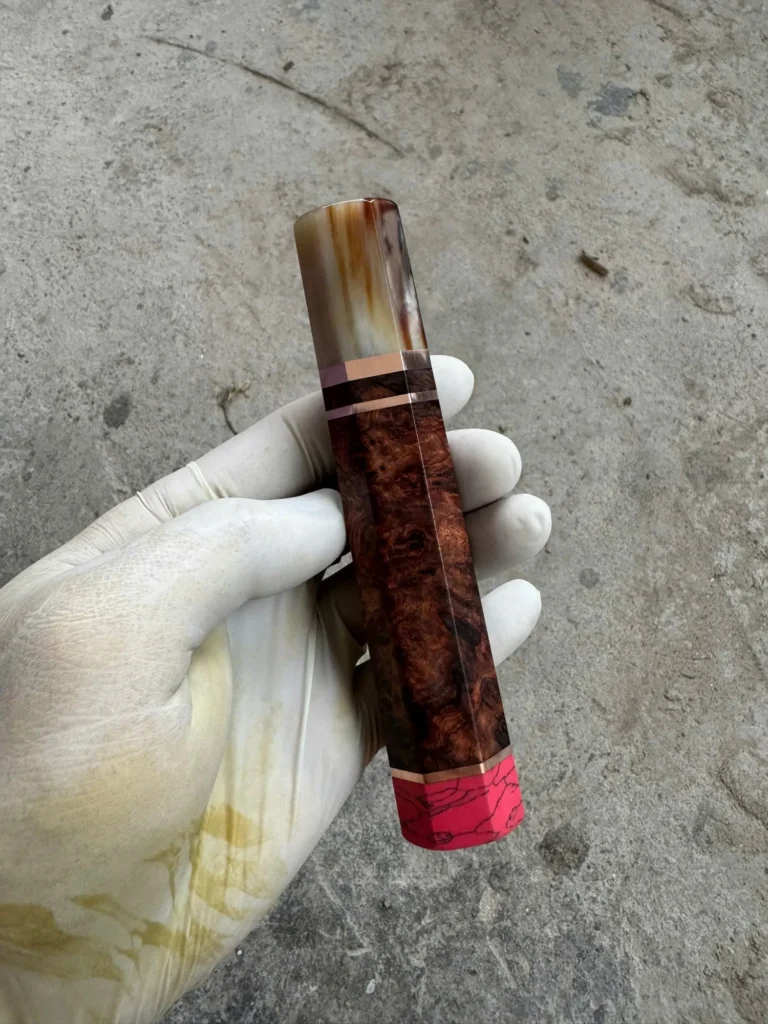
A custom handle
A custom wa handle is a made-to-order component for a particular Japanese knife, shaped around the recipient’s practical and aesthetic preferences. It can suit an enthusiast with a known favourite knife or someone who appears to have every general accessory already covered. This is the one category in this guide that we make. Before committing, confirm that the knife is suitable and involve the recipient wherever fit or taste cannot be known from the outside. Giving a wa handle explains how to preserve the occasion while coordinating the necessary choices, and the configurator shows the available decision path.
Classes and experiences
A class or guided experience turns the gift into time spent developing skill. It can introduce a new owner to confident knife use, help an experienced cook explore a focused technique or give the person who has everything something that does not occupy a shelf. Look for a level that matches current experience, a teaching format they will enjoy, practical scheduling and clarity about what participants need to bring. Flexible booking is useful when the recipient’s availability is uncertain.
Match the commitment to the occasion
For a small thank-you, a care kit or a contribution toward a shared experience can be a modest, useful gesture. The aim is recognition rather than transformation.
A birthday allows more room for a category tied to an observed need: a board for a constrained workspace, storage for a growing collection, a sharpening setup for someone ready to learn or a saya for a knife that travels.
For a wedding, housewarming or personal milestone, the gift can become a centrepiece: a substantial working surface, a class taken together, or a fitted or made-to-order object connected to a known knife. Greater commitment also justifies more coordination. Letting the recipient choose details can become part of the gift rather than something that diminishes it.
Timing, honestly
Fitted and made-to-order gifts are plan-ahead gifts. Late in the year, order early or make the reveal part of the gift, then complete the recipient-specific choices together instead of forcing an uncertain deadline.