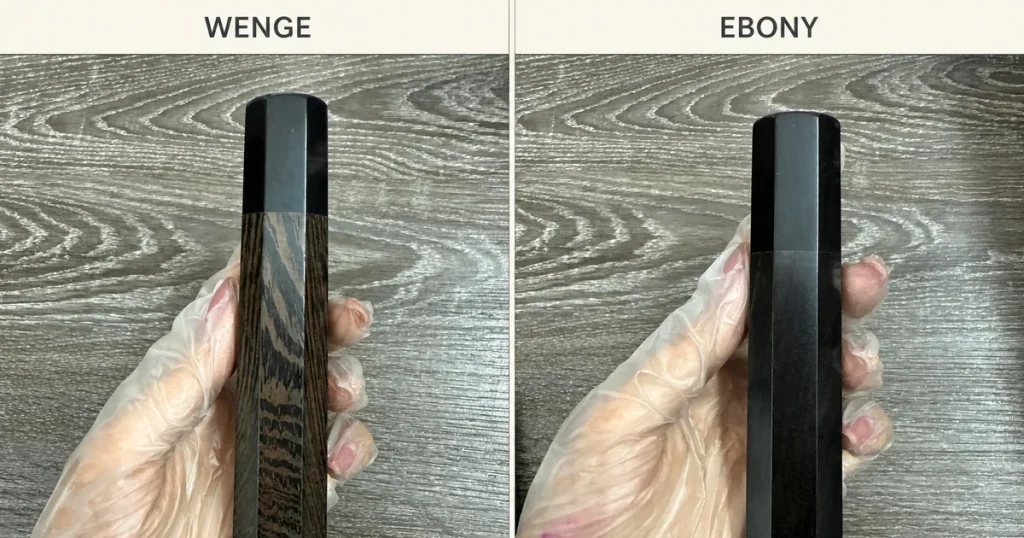
Short answer: choose wenge when you want dark wood with visible, linear grain; choose ebony when you want a quieter, potentially more uniform dark surface. Do not choose between them from a wood name alone. Horn & Grain’s public catalog identity fields declare wenge as Millettia laurentii and standard Ebony as Diospyros crassiflora. Those declarations describe the catalog options; they are not supplier or batch evidence for an individual handle. Finished handle dimensions, the particular blank, ferrule, end cap, and tang bore can matter more to weight and balance than the comparison suggests.
For a custom build, wenge is currently shown as available in the Horn & Grain configurator. Ebony is currently shown as available in the configurator. The store also has purchasable product pages for both woods, but a product page is not proof that every blank, horn color, or size is continuously available.
Wenge vs ebony at a glance
Wenge
- Public identity: the catalog declares Millettia laurentii; supplier and batch evidence still need confirmation.
- Appearance here: dark brown with strong, near-black linear grain.
- Custom-order path: shown as available in the configurator.
- Choose it visually when: you want the grain to remain part of the design.
Ebony
- Public identity: the catalog declares Diospyros crassiflora; supplier and batch evidence still need confirmation.
- Appearance here: dark, but the amount of brown and visible grain depends on the actual blank.
- Custom-order path: shown as available in the configurator.
- Choose it visually when: you want the darkest, least visually busy option, subject to the actual blank.
Measured fit and balance
- Compare finished handles of similar dimensions, not species averages.
- The current product pages do not support an exact gram-for-gram difference.
- Confirm finished weight, dimensions, ferrule, end cap, and tang-bore depth for each candidate.
Start with identity, not a generic density chart
The Royal Botanic Gardens, Kew accepts Millettia laurentii as the species commonly associated with wenge and records its native range in west-central tropical Africa. Horn & Grain’s public catalog identity field uses that same botanical name for its wenge option. That is a useful catalog declaration, but responsible product copy should still connect a finished handle to its supplier or batch rather than treating the field or a database entry as proof of an individual blank’s origin.
Ebony is a broad trade category, but Horn & Grain’s public identity field is more specific: it declares standard Ebony as Diospyros crassiflora. Kew accepts that species and records its black heartwood as a source of commercial ebony. The declaration still needs supplier or batch support before it can prove the identity of a particular blank. Horn & Grain also sells a separately named Macassar Ebony & Black Buffalo Horn handle; that separate trade name should not be substituted for the standard catalog declaration.
This is why a supplier record or batch statement is more useful than a confident-looking web table. If the seller cannot connect a particular ebony handle to supporting evidence, the honest description is “catalog-declared Diospyros crassiflora; supplier and batch evidence not published.” That limitation does not make the handle unusable. It tells you which provenance, density, and sourcing claims should not be made about that piece.
Appearance and surface feel
The current Wenge & Black Buffalo Horn handle describes a dark espresso-brown body with pronounced near-black grain. That strong line pattern is the practical visual difference: on an octagonal handle, the grain changes slightly from facet to facet and remains visible under a dark ferrule. Wenge is the better of these two directions when “dark, but visibly wood” is the brief.
Ebony can be close to uniform black, brown-black, or visibly striped. The correct comparison therefore uses photographs of the actual handle in neutral light—not a black color swatch and not a photograph of a different species. Horn & Grain currently offers separate black-horn and blonde-horn ebony listings. Black horn continues the dark silhouette; blonde horn creates an obvious transition before the blade. Natural horn also varies, so the ferrule photograph matters as much as the wood photograph.
Do not promise that one wood will always feel smoother. Wenge’s open-looking grain can remain visually pronounced after finishing, but the hand actually meets the maker’s surface preparation and finish. Ebony’s fine-looking surface can also feel poor if facets, edges, or finish are poorly executed. Ask whether the displayed piece is the piece being sold, what finish is on it, and whether the facets have been eased to the same degree.
Weight and balance: compare finished objects
Horn & Grain’s current catalog reference places its declared standard ebony above wenge in material density, so equal-volume ebony would tend to be heavier. That is a directional material reference, not the weight of either finished handle. Different dimensions, liners, ferrules, end caps, bores, and blanks can reverse the actual comparison, so ask for the finished weight of both candidates.
It is tempting to say “ebony is heavier” and stop. That shortcut is not reliable enough for selecting a handle. Even with the catalog’s Diospyros crassiflora declaration, supplier evidence, moisture content, and blank variation matter; a longer body, larger cross-section, horn ferrule, metal spacer, end cap, or deeper bore also changes the finished mass. Horn & Grain’s current wenge and ebony product pages do not publish matched dimensions and measured weights, so this article does not invent them.
If balance is the reason for the decision, request two numbers for each actual candidate: finished handle weight and finished dimensions. Then provide the knife’s blade length, current balance point, existing handle dimensions, and tang measurements. A few grams at the butt can be more noticeable than the same mass near the ferrule, and a handle that is simply too large can make a nimble knife feel slow regardless of species.
- For a knife that already feels rear-heavy, begin with the smaller or lighter measured handle—not a presumed “lighter species.”
- For a blade-forward knife that you want to calm, compare actual finished weights before adding decorative rear mass.
- For a replacement, confirm tang width, height, length, and intended insertion depth before discussing balance.
The wa handle size guide provides starting dimensions, while the configurator collects blade and tang information. Neither replaces a dry fit or a maker’s compatibility check.
Care is finish-specific
The USDA Forest Products Laboratory explains that wood exchanges moisture with its environment and that finishes slow moisture movement rather than eliminating it. For either handle, wash the blade without soaking the handle, wipe the handle dry promptly, avoid the dishwasher, and keep it away from sustained heat. Those are sensible controls at the wood, horn, and tang junction.
Do not follow a fixed oil schedule until you know the finish. An unfinished or oil-finished surface may accept a compatible maintenance product; a cured film finish may not. Adding oil over an unidentified finish can create a sticky surface without fixing a gap, loose tang, crack, or water ingress. Ask Horn & Grain to identify the finish supplied on the actual piece, then follow the care instruction for that finish.
Current Horn & Grain availability
As reviewed, wenge is a directly available custom-configurator material and the catalog has a purchasable wenge-and-black-horn product page. Ebony is available in the custom flow, while black-horn and blonde-horn ebony product pages are also purchasable. This is not a promise of perpetual stock: natural blanks, ferrules, and sizes change. Confirm the actual piece or custom material before planning around its color.
If ebony identity matters for sourcing, appearance, or travel, ask for confirmation that the actual material matches the public Diospyros crassiflora declaration and request the relevant supplier documentation before purchase. International trade controls can depend on species, product form, and destination. The current CITES checklist—not a generic blog summary—is the appropriate starting reference, and a catalog field by itself does not answer every compliance question.
Which one should you choose?
Choose wenge when the dark linear grain is the point, you like the current black-horn product direction, and the measured finished handle suits the knife. Choose ebony when you prefer a quieter dark field or a dramatic blonde-horn contrast, and you are comfortable selecting from the actual blank rather than assuming all ebony is jet black. Pause the decision when exact weight, dimensions, batch-supported identity, finish, or tang compatibility is important but unpublished.
The useful hierarchy is: compatibility first, measured size and weight second, actual blank and ferrule third, species story fourth. Following that order produces a handle chosen for the knife rather than a material label chosen for a search query.
Reviewed 7 August 2026. Method: current Horn & Grain public catalog identity fields, product pages, and configurator availability were checked against Kew records, and wood-care claims were checked against USDA Forest Products Laboratory guidance. Catalog declarations are reported separately from supplier or batch proof; no unpublished product weight, dimension, or provenance was inferred.
Primary references
- Royal Botanic Gardens, Kew: Millettia laurentii
- Royal Botanic Gardens, Kew: Diospyros crassiflora
- USDA Forest Products Laboratory: Wood–Moisture Relationships
- USDA Forest Products Laboratory: Finishing of Wood
- CITES Checklist
Compare a wenge or ebony build in the custom wa handle configurator